21.5.14

Egg Chasers

This illustration appears in many soccer history books, but  the roses on the jerseys tell us it is in fact a Rugby match- England vs Scotland at the Oval, 1872. 


In the early days, of course, an interest and proficiency in more than one code was unsurprising.  The rules of engagement were often a mishmash and would change from week to week according to the opposition and the mutual agreement of the captains. This, of course, was the very situation that the Football Association set out to counter. 

The very first encounter played under the 1863 rules was between two clubs, Barnes and Richmond, who later decided to follow the Rugby Union route. 
Several of the northern clubs converted (no pun intended) from Rugby to Association (notably Preston North End, Burnley and Manningham). Clapham Rovers alternated- Association one week, Rugby the next.

Some individuals excelled in both codes. Here are just a few examples:

Robert Barker kept goal for England during much of the first ever international match. In the absence of the preferred goalkeeper he was chosen due to his Rugby experience.

Henry Renny-Tailyour of the Royal Engineers represented Scotland (as a forward) in the second ever international Rugby Union match at the Oval in 1872. In fact it is on record that he was unavailable for subsequent Association matches due to an injury sustained in this match. In 1873 he played in the second international football match for Scotland, against England, again at the Oval, getting onto the score sheet. Scotland lost both these matches.  Renny-Tailyour won the FA Cup with Royal Engineers at the third attempt in 1875.

Reg Birkett was the scorer of the first try in international Rugby- for England vs Scotland in 1871. A dual-coder with Clapham Rovers, Birkett was on the original RFU committee and played for England 4 times.
Birkett was also an FA Cup winner with Rovers in 1880, his second Cup-Final appearance.
He kept goal for England in their 1879 5-4 win over Scotland at the Oval.

Dr. John Smith- as an Association player Dr Smith played in both the English and Scottish FA Cup finals. He was the first man to score 3 goals in  a Scottish Cup Final. He represented his country 10 times (1877-84), scoring 10 goals. His clubs were  Mauchline, Edinburgh University and Queen's Park. His football career was ended by the stringent anti professionalism laws of the Scottish FA (the Dr played as an amateur for Corinthians in a match against a team that included a professional, enough to get him banned!)
Playing Rugby for Edinburgh University, in 1888 Dr Smith was selected for the British Isles antipodean tour.
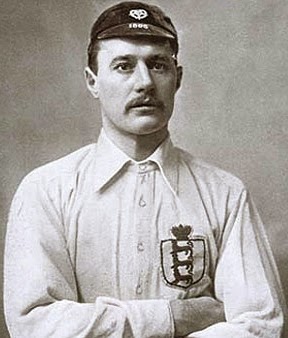


John Willie Sutcliffe - Rugby in the north of England was blighted by witch hunts against professionalism. In 1889  Sutcliffe represented England against New Zealand Natives, but later that year, his club, Heckmondwike, were thrown out of the RFU for professionalism.
Remarkably, Sutcliffe was then able to join Bolton Wanderers. His original role in Association had been as a forward, but he switched to goalkeeper and went on to make over 300 League appearances for Bolton before joining firstly Millwall Athletic and then Manchester United. In 1905 Sutcliffe joined Plymouth Argyle, for whom he made a further 200 plus League appearances. He ended his playing
 days at Southend, having been 24 years in professional soccer. He later went to the Netherlands and managed Vitesse Arnhem.
Sutcliffe was capped 5 times by England (1893–1903) as a goalkeeper.


Dai Davies was a half back with Llanelli. He joined Northern Union side Swinton in 1899. In the summer of 1902 Davies, who had only ever seen one soccer match and never played the game before, joined Bolton Wanderers as a goalkeeper (maybe Wanderers were inspired by the precedent of  Sutcliffe). He was a notoriously courageous 'keeper. He played in the 1904 FA Cup Final (completing an unique double, having played in the 1900 Northern Union Challenge Cup Final).
Davies spent 8 years at Bolton and was capped 3 times by Wales. He returned to Northern Union in 1910. 


20.5.14

Étoile des Deux Lacs


Étoile c1912- Internationalists have the France badge sewn over the star.

L'Étoile des Deux Lacs  was a Parisian club affiliated with the Fédération gymnastique et sportive des patronages de France. The club was founded in 1898 and was based in the  Bois de Boulogne (near 2 lakes, unsurprisingly).
Etoile was the major force in french football up to the time of the Great War, being 9 times winners of the leading competitions of the era:
Le Trophée de France winners 1907 and 1912.
Le championnat de France de football des patronages winners-1904-1905, 1905-1906, 1906-1907, 1910-1911, 1911-1912 and 1912-1913.
Coupe nationale FGSPF winners -1916.
Leading football administrators Charles Simon and  Henri Delaunay were leading figures in the foundation of the club.
The following players from Étoile represented France:


Period
Appearances
Jean Ducret
03.04.10 - 20.04.13
16
Henri Bellocq
09.05.09 - 01.01.11
6
Maurice Olivier
03.04.10 - 08.02.14
6
Henri Mouton
09.05.09 - 15.05.10
5
D. Mercier
03.04.10 - 15.05.10
3
Paul Romano
29.10.11 - 17.03.12
3
Auguste Tousset
16.04.10 - 12.01.13
2
Maurice Meunier
09.05.09
1
Gilbert Brébion
22.05.09
1
Henri Sellier
15.05.10
1
Félix Romano
20.04.13
1


The last time the club played at the highest level was in the Coupe de France in 1922.


19.5.14

The Umpire- Football Competition 1904

On 13.03.04 The Umpire, a Manchester based sports paper, published the result of its Football Competition, in which readers were asked to vote for their favourite player of the season. 
The number of votes cast is impressive, and it is revealing that 2 Northern Union (Rugby League) players make it into the top 10. In this era the words football and footballer were just as likely to be used in connection with rugby players. One can assume that the readers were predominantly northern working class men. 

Of the 10 association players in the 12 named, some will need no introduction to studentds of football history. Let's see:

1
Billy Meredith
Manchester City
The Wizard of Dribble was in his 10th season with Manchester City, The following month he scored the winning goal in the FA Cup final.

2
Steve Bloomer
Derby County
One of the most prolific goalscorers in football history. He finished the 1903-04 season as the Division one top scorer for the 5th time in his career.

3
Bob Crompton
Blackburn Rovers
A full back who represented England a remarkable 41 times, captain on 21 occasions. At the time of the prize Crompton was England captain and had just won his 7th cap.

4
Ernest Needham
Sheffield United
Nudger represented England 16 times and won both the League and FA Cup with United. He was a half back who struck a balance between attacking and defensive play.

5
Tom  Baddeley
Wolverhampton Wanderers
The goalkeeper won his 5 England caps in 1903-04.

7
William Foulke
Sheffield United
The big man was always a popular figure with the public.

8
Sammy  Frost
Manchester City
Frost played half back for City.

9
Jack Sharp
Everton
Sharp was a double international (cricket and football). He signed for Everton in 1899 and was in the national team in 1904. He was an inside forward.

11
Jimmy  Settle
Everton
Notoriously fast, represented England 6 times between 1899 and 1903.

12
George  Ross
Bury
Won 2 FA Cups with Bury.

16.5.14

The Football Association Tour of South Africa- 1910

Some 11 years after it had made its first foray overseas The Football Association undertook an ambitious tour of South Africa. The 18-man squad left Southampton on May 7th  for the 17-day voyage to South Africa. 
Corinthian FC had previously visited South Africa in 1897,1903 and 1907,  playing 'tests' against  a national XI, and the 'Springboks' had been as far as Argentina and Brazil in 1906.
The game was well established in South Africa, and 1910 was also the year in which they became members of FIFA.

Manager: Charles Hughes
Amateur Players:
Arthur Berry (Everton)*
James Raine (Glossop)"
Ivan Sharpe (Glossop)"
Vivian Woodward (Chelsea)*"
Professional Players:
Bob Benson (Sheffield United)*
Joe Bulcock (Crystal Palace)
Dick Duckworth (Manchester United)
Harold Fleming (Swindon Town)*
Vince Hayes (Manchester United)
Billy Hibbert (Bury)*
George Holley (Sunderland)*
Joe Leeming (Brighton and Hove Albion)
Joe Lievesley (Sheffield United)
George Richards (Derby County)*
Billy Silto (Swindon Town)
Albert Sturgess (Sheffield United)*
George Wall (Manchester United)*
Billy Wedlock (Bristol City)*
Gordon Wright (Hull City)*


(Ivan Sharpe replaced Gordon Wright 03.06.10)
* England full internationals
"English amateur internationals 


Vivian Woodward


Vivian Woodward enjoyed a particularly fruitful tour, getting 32 goalsin the 23 matches. An 18-man squad left Southampton on May 7 for the 17-day voyage to South Africa where they embarked on a 23-match tour, spanning nine weeks. Nine of the squad had previously played in full internationals (though one-Wright- withdrew after two games because of injury), whilst another two went on to win full caps.The tour coincided with the formation of the Union of South Africa.


26.05.10
Colonial born of Cape Town 
1
7
English FA XI
Cape Town           
28.05.10
Western Province 
0
13
English FA XI
Cape Town           
01.06.10
Griqualand West 
0
2
English FA XI
Kimberley
04.06.10
Griqualand West 
1
7
English FA XI
Kimberley
08.06.10
Bloemfontein
0
4
English FA XI
Bloemfontein
11.06.10
Johannesburg District 
1
6
English FA XI
Johannesburg
Some sources describe the home team as The Reef
13.06.10
West Rand 
1
3
English FA XI
Krugersdorp
15.06.10
Pretoria District 
1
4
English FA XI
Pretoria 
18.06.10
Transvaal
0
1
English FA XI
Johannesburg
Some sources give Johannesburg District as opponents
20.06.10
Klip River District 
3
13
English FA XI
Ladysmith
22.06.10
Pietermaritzburg
0
6
English FA XI
Pietermaritzburg
25.06.10
Natal
2
6
English FA XI
Durban
29.06.10
South Africa 
0
3
English FA XI
Durban
02.07.10
Frontier
0
7
English FA XI
East London                           
04.07.10
Frontier
0
6
English FA XI
King William's Town                   
06.07.10
Port Elizabeth District 
0
8
English FA XI
Port Elizabeth         
09.07.10
Eastern Province 
0
10
English FA XI
Port Elizabeth         
12.07.10
Grahamstown District 
0
9
English FA XI
Grahamstown
16.07.10
Rand League 
1
2
English FA XI
Johannesburg  
Some sources give Orange River Colony as opponents and Bloemfontein the venue
20.07.10
East Rand 
0
5
English FA XI
Vogelfontein
23.07.10
South Africa 
2
6
English FA XI
Johannesburg 
27.07.10
Western Province 
0
9
English FA XI
Cape Town                         
30.07.10
South Africa 
3
6
English FA XI
Cape Town                         


Billy Hibbert

South Africa
0
3
English FA XI
29.06.10 Durban (5,000)


Hibbert (3)

Hawkins

Joe Lievesley
J Ford

Bob Benson
Sricker

Joe Bulcock
Cairns

George Richards
Lincoln

Billy Wedlock
Lamont

Albert Sturgess
Gorton

James  Raine
Saby

Vivian Woodward (c)
Baird

Billy Hibbert
Martin

George Holley
Lowe

George Wall

Harold  Fleming

South Africa
2
6
English FA XI
23.07.10 Johannesburg (13,000)


Messer, Hartigan

Fleming (2), Wall, Woodward (2), Holley

Baird

Joe Lievesley
Lincoln

Bob Benson
Messer

Joe Bulcock
G Hartigan

Dick Duckworth
Rimmer

Billy Wedlock
J Ford

Albert Sturgess
Martin

James  Raine
Mitchell (c)

Harold  Fleming
Vivian

Vivian Woodward
Hawkins

George Holley
Salzwedel

George Wall

George Holley

South Africa
3
6
English FA XI
30.07.10 Cape Town (5,000)


Leeming (og), Lincoln, Hartigan


Fleming, Berry, Holley (2), Woodward (2)
J Ford

Joe Lievesley
Robertson

Bob Benson
Baird

Joe Leeming
Martin

George Richards
Messer

Billy Wedlock
Vivian

Billy Silto
G Hartigan

Arthur Berry
Salzwedel

Harold  Fleming
Commaille

Vivian Woodward (c)
Lincoln

George Holley
Upton

George Wall