Showing posts with label Royal Engineers. Show all posts

15.4.15

Royal Engineers v Wanderers

In the 1870s there were few serious competitors aside from Wanderers and the Royal Engineers for the title of the best club in England. It was fitting that these 2 sides contested the first FA Cup Final, and there was a period from 1871 -1875 when the Royal Engineers won just about every game that they played other than FA Cup Finals. Wanderers of course won the FA Cup 5 times in 7 seasons. In the previous decade matches between the 2 had been far more casual in nature. Here's an account of an early meeting in which the military metaphors are done to death, Note that the mention of the after match hospitality was almost obligatory in football journalism during the 18th century. Its a curious team list as well...


Kentish Chronicle-19.11.64

Four years later the Wanderers don't come across as one of the leading clubs, managing to muster only 8 players for a home fixture and failing to ensure that there was a football available! The thoughts of the Engineers on travelling up from Chatham for a 35 minute game are unrecorded. As Charles Alcock may (or may not) have said, its a funny old game... 

Bell’s Life in London and Sporting Chronicle - 05.12.68


7.3.15

Henry Renny-Tailyour


Born in India, raised in Montrose, educated at Cheltenham College and Royal Woolwich Military Academy. Henry Waugh Renny-Tailyour was a great all round sportsman.
In May 1870 in the games between the 2 Royal Military Academies, Woolwich and  Sandhurst , he won the 1/2 mile  race ( in 2 mins 10), and finished  2nd in the mile.  The following month Renny-Tailyour scored a century in the cricket match between the Royal Military Academy  and the Royal Engineers. In July 1870 he graduated from the Academy and became a Lieutenant in the Royal Engineers.
In 1871 Renny-Tailyour represented Scotland in the  4th match in the unofficial 'England v Scotland' series, played at The Oval on 18th November. Renny -Tailyour scored  in a 2-1 defeat. 
Further evidence of the Lieutenant's versatility came when on 5th February 1872 at The Oval when he played (as a forward) in the second ever  international under Rugby Football rules. A dead leg received in this match kept Renny-Tailyour out of action for the next couple of weeks, meaning he was unable to play in the 5th 'Alcock International'.
On 16th March that year however he was back at The Oval, playing in the first FA Cup Final, in which the Royal Engineers went down 1-0 to The Wanderers. 
In 1873 Renny-Tailyour became the only man to represent Scotland at both Rugby and Association when he was one of 4 English based players called into service for the 2nd international. The Oval was again the venue, and in the 10th minute, with England 2-0 ahead, Renny-Tailyour scored Scotland's first ever goal in international football. (England won 4-2).

Renny-Tailyour features prominently in match reports of the Royal Engineers' club matches during the early 1870s, a period during which they were a major force in terms of both results and the evolution of style. In 1871-72 they lost just 1 out of 20 games (the FA Cup Final) scoring 73 to 2. In the 4 seasons 1871-72 to 1874-75 the stats were:


P
W
D
L
F
A
86
74
9
3
244
21

Another of those very rare defeats came in the 1874 FA Cup Final, a 2-0 loss against Oxford University.
  Renny-Tailyour won the FA Cup with Royal Engineers at the third attempt in 1875. In a replayed final The Sappers beat Old Etonians 3-0, (after a 1-1 draw), with Renny-Tailyour scoring in both matches.


This seems to have marked the end of Renny-Tailyour's football career. He married in the summer of 1875 (his wife was the sister of  Royal Engineers teammate and England internationalist Cecil Wingfield-Stratford).

During the 1875-76 season he was being written about in the  past tense in football reports ruing the decline in the Royal Engineers team (and partly attributing this decline to the 'loss' of Renny-Tailyour).
In March 1876 he was appointed Aide De Camp to the Lord Lieutenant of Ireland.
One aspect of Renny-Tailyour's sporting life persisted into the 1880s. His first class cricket career extended from 1873 to 1883. He represented MCC and Kent as well as playing in the Gentlemen v Players matches. In 1880 he scored 266 for Royal Engineers against The Civil Service, an uncommonly high score at the time.  


24.1.15

Fixtures 1869-70

A fixture list of metropolitan matches from Bell’s Life in London and Sporting Chronicle (27.11. 1869). No distinction is made between the codes. In an exoticism sadly lost from the Association game,  Wasps, Owls and Flamingoes  feature alongside Pirates, Gipsies and Gitanoes.
Several of these clubs featured in the early years of the FA Cup. The legendary Wanderers were playing their home fixtures at The Oval cricket ground ( courtesy of Mr Alcock). CCC (Civil Service), Barnes and Royal Engineers still play. The Crystal Palace name survives, but it is an entirely different club. 


28.6.14

Royal Engineers

The Officers of The Royal Engineers, Chatham. A formidable outfit, early advocates of combination play, pioneers of the pyramid formation that dominated the game for 50 years.
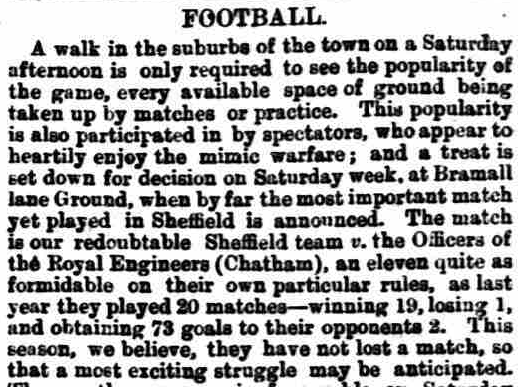
In 1871-72 they were reckoned (according to contemporary reports) to have lost only 1 out of 20 games played (which would have been the FA Cup final), scoring 73 and conceding only 2. The central figure in this group is Francis Marindin.
The Royal Engineers team was made up of officers- in the 1872 and 1875 Cup Finals 2 Captains and 9 Lieutenants, 1874 a Major (Marindin) a Captain and 9 Lieutenants, 1878 11 Lieutenants.
Poignantly the Royal Engineers' last FA Cup campaign came in the watershed season of 1882-83 when the Cup went north for the first time.


22.2.14

Officers of The Royal Engineers (Chatham) on Tour


In December 1873 the Royal Engineers went on tour to Sheffield and the Midlands. The Engineers team were all serving officers and the tour was arranged around periods of leave.
The three games played are often credited with introducing the Combination Game to a wider audience.
Although the exact origins of a systematic approach to playing association football in concert with one's team mates is very difficult to pin down, but documentary evidence supports the deployment of such tactics by the Engineers from the late 1860s, predating the culture shock of the 1872 England Scotland international in which the 11 Queen's Park players used tactics that were supposedly completely alien to the English. 


Sheffield and Rotherham Independent 09.12.73


The Sheffield Daily Telegraph 22.12.73

The Engineers were an adaptable lot- they were not averse to playing Sheffield rules (they went as far as playing Rugby rules on occasions). Note the reference to the throw in and the Sheffield reporters preference for the kick in. I remember a similar debate re surfacing in the 1980s!
The Sheffield FA team who played against Glasgow in the 1870s were in turn praised and damned for using a combination game unusual among English sides. 
The Mr Owen referred to is Rev. John Robert Blayney Owen. He later played for England. Owen was at Trent College and would have turned out for Derbyshire had it not been for the injury he sustained in the match at Sheffield. 
H.W Renny-Tailyour was injured for the Sheffield game, which he umpired. He returned for the Derbyshire game. 

The Derbyshire Times 24.12.73

A capital luncheon- before the match, and a splendid banquet afterwards.  It is implied that a different set of rules was employed in each half of the Derby game. 

The Standard 26.12.73
Nottingham Forest had been in existence since 1865. Their splendidly Dickensian named captain, Samuel Weller Widdowson, known as the inventor of shinguards, was impressed by the Engineers' use of a pyramid formation. During the course of the nest decade this became standard throughout Association Football.


20.12.73
Sheffield Association
0
4
Royal Engineers
Bramall Lane


Rawson, Van Donop, Olivier (2)

c 3,000
22.12.73
Derbyshire
1
2
Royal Engineers
South
Derbyshire CC

Gadsby


Rawson, Van Donop

23.12.73
Nottingham Forest
1
2
Royal Engineers
Trent Bridge

Spencer


Van Donop, Ellis


28.8.12

Francis Marindin

The Major
 Francis Marindin  was a captain in the Royal Engineers when he played in the first FA Cup Final in 1872. He appeared in the final again  in 1874, but was on the losing side both times.
Marindin had been responsible for founding the Royal Engineers club, who were to the forefront of the move from individualistic play to the Combination Game based on passing.
'The Majaw' went on to become a highly respected referee,and also felt that it was appropriate to his position as chairman of the Football Association to take charge of the most prestigious matches. Consequently from 1880 to 1890 he refereed 9 FA Cup finals.
 Marindin disapproved of the advent of professionalism and the use of Scottish players by the northern professional clubs. For this reason he congratulated West Bromwich Albion after a cup semi final win over Preston in 1887 (a game that he had refereed) and told them that he hoped they would win the final (in which he also officiated!) . They didn't though, they lost to a slightly Scottish flavoured Aston Villa.

During The Major's 18 year involvement in the FA Cup it moved from being a minority diversion for amateurs (the 1872 final watched by 2000) to a mass spectator sport increasingly dominated by professionals 
(20,000 watched The Major's last final in 1890, in which Blackburn Rovers beat The Wednesday 6-1).
Note: during his career Marindin would have adjudicated from the touchlines- the referee only 'entered the field of play' in 1891.

18.7.12

The FA Cup Final 1872

Wanderers 1-0 Royal Engineers

Kennington Oval
Saturday 16 March 1872
 Referee: A. Stair (Upton Park)

 
Wanderers: R. de C. Welch; C.W. Alcock, M.P. Betts, A.G. Bonsor, E.E. Bowen, W.P. Crake; T.C. Hooman, E. Lubbock, A.C. Thompson, R.W.S. Vidal, C.H.R. Wollaston
Goals: Betts
Following a long solo run from Vidal, 24 year old Morton Betts (playing under the pseudonym A.H Chequer) shot home from an acute angle in the 15th minute.
 Based in Battersea, Wanderers went on to win  five FA Cup finals in seven years. Players were selected from various former public school clubs but as these began to enter the FA Cup, Wanderers disbanded in 1887.


Royal Engineers: Capt. Merriman, Capt. Marindin , Lieut. Addison, Lieut. Creswell, Lieut. Mitchell, Lieut. Renny-Tailyour, Lieut. Rich, Lieut. Goodwyn, Lieut. Muirhead, Lieut. Cotter, Lieut. Bogle.
 The Engineers were pre match  favourites. Based at Chatham and formed in 1862 under the captaincy of  Captain (later Major) Francis Marindin, The Engineers were noted for their use of  the Combination Game, based on passing, whereas other teams relied almost solely on individualist play and dribbling tactics.  In the final  they were effectively reduced to ten men in the tenth minute when Lieutenant Creswell broke his collar-bone (he stayed on, but was a virtual spectator). They appeared in a further 3 FA Cup finals, winning in 1875.


The trophy was actually presented at a celebration dinner the following month.