Showing posts with label Trophies. Show all posts

16.1.17

1930


Gold medals from the 1930 World Cup. These were presented to Hector Scarone and Jose Leandro Andrade. The 18 carat medals measure 4cm x 2cm and weigh 25 grammes.
The Uruguayan Football Association also presented the players with replicas of the Trophy 'Victory', later named in honour of Jules Rimet.


This model was the property of Uruguay captain, Jose Nasazzi.


2.5.16

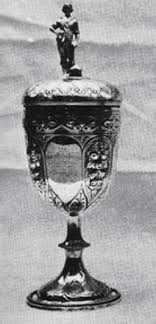
The Edinburgh Cup

By my reckoning this competition (still played for today in the guise of the East of Scotland Shield) is the third oldest Association football cup tournament in the World. This despite the apparent slowness of the east of Scotland in taking to the game (Rugby was the favoured code).


Hibernian 1880


11.03.76
Third Edinburgh Rifle Volunteers
6
0
Thistle

3ERV became St Bernard’s in 1878.

1876–77
Thistle
Walk over
Third Edinburgh Rifle Volunteers

Revenge after a fashion for Thistle as 3ERV did not turn up.

20.04.78
Heart of Midlothian
3
2
Hibernian

This match required 4 replays to produce a winner, and is credited with cementing the popularity of both clubs.

1
09.02.78
Heart of Midlothian
0
0
Hibernian


2
16.02.78
Heart of Midlothian
1
1
Hibernian


3
23.02.78
Heart of Midlothian
1
1
Hibernian


4
06.04.78
Heart of Midlothian
1
1
Hibernian


5
20.04.78
Heart of Midlothian
3
2
Hibernian


29.03.79
Hibernian
2
0
Heart of Midlothian

Another replay, following a 1-1 draw (01.03.79) . 4,000 watched the first match, whereas the average attendance for the 5 matches the previous season had been 1200.

20.03.80
Hibernian
5
0
Dunfermline

Another replay, albeit in different circumstances. Hibernian won the original match (06.03.80) by 6 goals to 3. Dunfermline protested that crowd encroachment had affected the game so a rematch was ordered. Dunfermline were not connected with the present day Dunfermline Athletic

02.04.81
Hibernian
1
0
St Bernard’s

Hibernian were awarded the trophy in perpetuity having won it 3 times in succession.


3.10.15

Copa Ricardo Aldao

Copa Aldao trophy.jpg
As we have seen , the tradition of trans Platense football dates back to 1889, and Argentine and Uruguayan teams had been playing each other since Albion crossed the river to play Retiro and Belgrano in 1896.

During the first quarter of the 20th century there was something of a mania for copas contested by leading teams from the 2 republics. 
The Copa Ricardo Aldao (also known as the Copa Rio de la Plata and the Campeonato Rioplatense) was established by Dr. Ricardo Camilo Aldao, president of Federación Argentina de Football (1912-1914) and Asociación Argentina de Football  (1918-1919). He was also the president of the Buenos Aires club Gimnasia y Esgrima.
The initial edition of the Cup was due to take place in 1913. Federación Argentina de Football champions Estudiantes took on Liga Uruguaya winners River Plate. Or did they? According to Argentinian historian Miguel Bionda (author of Historia del Fútbol Platense) Estudiantes won 4-1 (in a match played at Montevideo on 17.05.14). Contemporary newspaper reports state that  the game was either abandoned or not played at all due to torrential rainfall. It is speculated that Snr.Bionda has misattributed the result of one of three friendlies played between Estudiantes and River Plate in 1913.


The cup was definitely contested in 1916. On December 3rd at Buenos Aires Nacional defeated Racing Club de Avellaneda 2-1. Both clubs enjoyed a period of considerable dominance in domestic football. Racing won seven consecutive championships from 1913 to 1919.
In 1917 the same two sides drew 2-2 in Montevideo. The trophy was awarded to Racing Club as they were the visitors. 


In 1918 Racing Club defended the trophy successfully on home soil, defeating Peñarol 2-1.
1919 saw a home town victory for Nacional, defeating Boca Juniors 3-0. The same clubs met again on the opposite side of the River Plate in 1920. Nacional again emerged victorious, by 2-1.

The competition then became somewhat sporadic.
San Lorenzo de Almagro travelled to Montevideo and defeated Rampla Jniors (1-0) in 1927.
In 1928 Peñarol won the trophy with a 3-0 win over Huracan at Buenos Aires.


The competition was revivied in the 1930s. Club Athletico River Plate of Buenos Aires enjoying successive wins over Peñarol in 1936 and 1937.

21.10.12

The FA Cups


The first  FA Cup was in use from 1872 until 1895. Smaller than the modern version, it was less than 45cm tall, the trophy was made by Martin, Hall & Co and cost  the Football Association £20. 
The original concept of the FA Cup was that it should be a challenge cup competition in the true sense of the word- the teams playing in the second edition were competing for the right to challenge the Wanderers, the first winners, who received a bye to the final. In keeping with this set up the rules also stated that any team winning the trophy for three successive years would keep it. When the Wanderers achieved this distinction in 1877/1878 they returned the trophy to the FA on the understanding that no other team would retain it in the case that they won it three times in a row (in the FA Cups long history only Wanderers and Blackburn Rovers have achieved this).
On 11th  September 1895 the original trophy was stolen from a shop in Birmingham where it had been put on display by the holders, Aston Villa. A £10 reward was offered  but the cup was never recovered. The FA  fined Aston  Villa £25 to pay for a new trophy.
From 1896-1911 a replica of the original trophy was used. The design had been much copied, and the FA decided to introduce a completely new cup. The replica was presented to Lord Kinnaird in recognition of his 21 years as FA president. 
The new trophy was designed by Fattorini and Sons of Bradford. 
 This trophy  is now too fragile to be used and a replica was brought in for the 1993 season.