Showing posts with label Huracán. Show all posts

2.5.17

José Laguna

Image result 


José Durand Laguna, known as 'El Negro', was a prolific forward for Huracán. 
He represented Argentina 4 times, scoring 3 goals.
His debut came in unusual circumstances. At the 1916 South American Championship of Nations Laguna went to watch the Argentina vs Brazil game at Gimnasia y Esgrima in Buenos Aires (10.07.16).
Alberto Ohaco was unable to play and Laguna was called from the stand to fill the vacancy. 
He gave Argentina the lead in the 10th minute. The game finished 1-1.
Laguna later moved to Paraguay where he played for Olimpia. He also managed the Paraguay national side at 2 South American Championships and the 1930 World Cup.


30.10.15

Bologna & Torino- South American Tour, 1929


Just 3 weeks after the decisive play off match that closed the 1928-29 Italian season, champions Bologna and runners up Torino were in South America on tour. The 2 squads sailed together from Genoa on the Conte Rosso.
The 2 sides had shared 205 goals during the domestic league season, Torino's Trio of Wonders (Rossetti, Libonatti and Baloncieri) scoring 89 between them. 
Following such an arduous season it is perhaps unsurprising that neither side was spectacular on tour. In fact one Torino historian went as far as to describe the excursion as a 'celebratory holiday'. 
 Bologna bolstered their ranks with guests:


Bologna- Gianni, Monzeglio, Gasperi, Genovesi, Baldi, Pitto, Martelli, Schiavio, Busini , Muzzioli (Bologna); Compiani, Tansini (Milan); Dugoni (Modena) Ferrari,  Banchero (Alessandria), Magnozzi (Livorno) , Costantino ( Bari).

I don't know the composition of the Torino squad, but among the tourists was  Roma's Rudolfo Volk, a future Capocannoniere.
Torino's Libonatti faced both his former club (Newell's Old Boys) and his former national team (Argentina).

25.07.29
Carioca Select
3
1
Bologna
28.07.29
Paulista Select
6
4
Bologna
30. 07.29
Corinthians
6
1
Bologna
10.08.29
Uruguay
0
1
Bologna
15.08.29
Argentina
3
1
Bologna
18.08.29
Argentina B
0
0
Bologna
21.08.29
Newell's Old Boys
2
1
Bologna
24.08.29
Huracan
2
1
Bologna
25.08.29
Argentina del Sud
1
Bologna
27.08.29
Boca Juniors
1
0
Bologna
30.08.29
Estudiantes de La Plata
3
3
Bologna
01.09.29
Santa Fè
3
0
Bologna
08.09.29
Palestra Italia
4
4
Bologna
10.09.29
Carioca Select
1
3
Bologna
14.09.29
Paulista Select
3
1
Bologna

P
W
D
L
F
A
15
3
3
9
23
38


28.07.29
Argentina
1
0
Torino
03.08.29
Argentina B
1
1
Torino
04.08.29
Argentina
4
1
Torino
08.08.29
Estudiantes de La Plata
5
0
Torino
10.08.29
Independiente
1
2
Torino
15.08.29
Rosario League
2
4
Torino
18.08.29
Newell's Old Boys
2
0
Torino
25.08.29
Uruguay
5
1
Torino
31.08.29
Peñarol
1
1
Torino
07.09.29
Carioca Select
6
0
Torino
10.09.29
Carioca Select
2
1
Torino
13.09.29
Palestra Italia
0
0
Torino
14.09.29
Paulista Select
6
1
Torino


P
W
D
L
F
A
13
2
3
8
12
36


3.10.15

Copa Ricardo Aldao

Copa Aldao trophy.jpg
As we have seen , the tradition of trans Platense football dates back to 1889, and Argentine and Uruguayan teams had been playing each other since Albion crossed the river to play Retiro and Belgrano in 1896.

During the first quarter of the 20th century there was something of a mania for copas contested by leading teams from the 2 republics. 
The Copa Ricardo Aldao (also known as the Copa Rio de la Plata and the Campeonato Rioplatense) was established by Dr. Ricardo Camilo Aldao, president of Federación Argentina de Football (1912-1914) and Asociación Argentina de Football  (1918-1919). He was also the president of the Buenos Aires club Gimnasia y Esgrima.
The initial edition of the Cup was due to take place in 1913. Federación Argentina de Football champions Estudiantes took on Liga Uruguaya winners River Plate. Or did they? According to Argentinian historian Miguel Bionda (author of Historia del Fútbol Platense) Estudiantes won 4-1 (in a match played at Montevideo on 17.05.14). Contemporary newspaper reports state that  the game was either abandoned or not played at all due to torrential rainfall. It is speculated that Snr.Bionda has misattributed the result of one of three friendlies played between Estudiantes and River Plate in 1913.


The cup was definitely contested in 1916. On December 3rd at Buenos Aires Nacional defeated Racing Club de Avellaneda 2-1. Both clubs enjoyed a period of considerable dominance in domestic football. Racing won seven consecutive championships from 1913 to 1919.
In 1917 the same two sides drew 2-2 in Montevideo. The trophy was awarded to Racing Club as they were the visitors. 


In 1918 Racing Club defended the trophy successfully on home soil, defeating Peñarol 2-1.
1919 saw a home town victory for Nacional, defeating Boca Juniors 3-0. The same clubs met again on the opposite side of the River Plate in 1920. Nacional again emerged victorious, by 2-1.

The competition then became somewhat sporadic.
San Lorenzo de Almagro travelled to Montevideo and defeated Rampla Jniors (1-0) in 1927.
In 1928 Peñarol won the trophy with a 3-0 win over Huracan at Buenos Aires.


The competition was revivied in the 1930s. Club Athletico River Plate of Buenos Aires enjoying successive wins over Peñarol in 1936 and 1937.
20.2.15

El Palomo


Bologna were the Italian champions of  1928-29. Just a fortnight after the decisive play off match both Bologna and runners up Torino were in South America on tour. One of the highlights of the tour was the clash between Bologna and Argentina on 15.08.29 which Argentina won 3-1 and in which  Bartolucci of Huracán figured prominently at right half.
The photographs above show Bartolucci executing the move that earned him the nickname Palomo (The Dove)- for it was he who introduced la palomita- the diving header.
Bartolucci was also instrumental in setting up Asociación Mutual de Jugadores, which led to the professionalization of Argentinian football in 1931.

Argentina and Bologna, 15.08.29

13.2.15

The club named after a balloon?


IDecember 1909 the Argentine aviator Jorge Newbery made an historic balloon flight (550 km in 13 hours) covering Argentina, Brazil and Uruguay. The balloon was called El Huracán.
The Nueva Pompeya suburb of Buenos Aires had been home to a football team since 1903 when  Los Chiquitos de Pompeya was founded by local schoolboys. In 1905 this outfit evolved into Defensores de Ventana. In 1907 the decision was made to step up into a more organized level of football. A change of  name was again proposed - the poetic   Verde esperanza y nunca pierde being chosen. Legend has it that when the club members went to have an official rubber stamp made the name was changed to Huracán because it was cheaper to have printed and that Huracán was chosen because it appeared on a poster in the window of the shop.
Further reorganization came in November 1908- a merger with Pompeya con Parque Patricios. This is recognized as the official foundation of Club Atlético Huracán.
Notice though that these events pre date the voyage of Newbery. The balloon Huracán arrived in Argentina in 1909- Newbery first piloted it in June of that year. The chance selection of the name Huracán at the printers and the name of the famous balloon was a coincidence.

The association between the club and the aviator developed after the famous flight. The club approached Newbery for permission to use the balloon image as a crest. Newbery approved and was made an honorary President of the club. Newbery also helped the club to acquire a better playing venue and to become affiliated to the Argentine Football Association.
Consequently in 1912 they participated in the 3rd tier of Argentinian championship football (meaning they could only field players aged under 18 for league matches), and they won promotion for 2 successive seasons.  


Club Atlético Huracán, 1913- notice the balloon on the badge is very large.


First appearing in the Primera División in 1914, Huracán were champions in 1921, 1922, 1925 and 1928.
1928


3.5.13

Cesáreo Onzari


A great picture of  Huracán's Cesáreo Onzari placing the ball for a corner kick. 
A one club man, Onzari  played  over 200 games for Huracán (1921-1933), winning  4 championships (1921192219251928).
He represented Argentina 15 times.

20.4.13

Juan Alberto Estrada


Juan Alberto Estrada's finest moments came after 1937, when our study of Association Football ends However, in 1937 he won a Copa America with Argentina, and moved to Boca Juniors.
This picture from El Grafico shows Estrada in action for Huracán, for whom he played over 100 times from 1933-37, making his debut for Argentina in 1936.

8.12.12

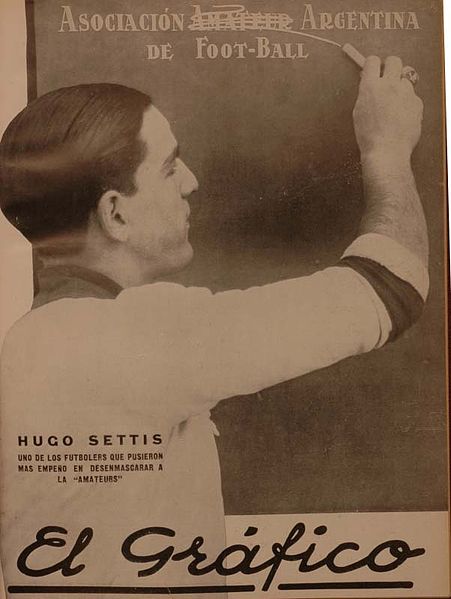
Hugo Roque Settis- Queríamos ser libres

Football in Argentina was officially amateur up until 1931. In practice most players were paid. The clubs applied very strict rules regarding the movement of players. Amongst the players the most unpopular of these rules was the ley candado (the padlock law)- this meant that no player could move from one club to another without the first club's consent. This is of course completely understandable in the context of professional, contracted players. But the Argentine players were officially amateurs.
The conflict between clubs and players escalated. A players union-Asociación Mutual de Jugadores- was formed.  The two main figures in the union were the Huracán players Hugo Roque Settis and Juan Pablo Bartolucci .
The players went on strike, and even marched to the headquarters of the Government to present their protest to President Uriburu.
The outcome was a structured professional set up, 12 leading clubs openly declaring themselves professional, which led to a culture of  proper wages and contracts.


We wanted freedom of contract, we wanted to end the club's exclusive hold on us, and to be able to decide who we played for. We wanted to be free.
Settis

2.12.12

Guillermo Stábile


Guillermo Stábile played for Buenos Aires club Huracán from 1924-30.
He had a brief but spectacular international career.
Called up for the 1930 World Cup he scored a hat trick on his debut against Mexico. 
 Stábile got two goals in the next match against Chile and another two in the semi final against the USA.
In the final against Uruguay a Stábile goal put Argentina 2-1 up.

Following the World Cup he signed for Genoa, thus beginning a successful career in Europe but ending his international career. 
So, his international career lasted 11 days, spanning 4 matches during which he scored 8 goals. 

As well as Genoa Stábile  played for Napoli and Red Star Paris. He later managed the Argentina national team in over 100 matches.