Showing posts with label Francis Marindin. Show all posts

5.12.17

FA Cup Final, 1889


Here is a programme for the 1889 FA Cup Final between Wolverhampton Wanderers and Preston North End's Invincibles (the Cup version, with Mills- Roberts in the place of Trainer).
Major Marindin would undoubtedly have been rooting for Wolves' English XI (including 7 internationals).  Wolves had finished 3rd in the League,  conceding 9 goals across the 2 meetings with Preston.
DewhurstRoss and Thomson were the scorers as Preston won 3-0 to secure the Double. 


21.8.17

Scotland v England 1884


Played at Cathkin Park 15.03.84.
This was the inaugural season of the British Home Championship and the Scotland England clash was always likely to be the decider. This was the 13th meeting between the 2 sides. Scotland had won 8 of the previous 12 matches and England had not beaten them since 1879.
For the first time in international football admission was by ticket only.
Dr John Smith scored the only goal of the game in the 8th minute to give Scotland a 1-0 victory.
The illustration shows 'A Bailey' but it is in fact Norman Coles Bailey, while E.C Bambridge Swift is E.C Bambridge of the club The Swifts. Francis Marindin , here acting as Umpire for England was so well known as to be recognizable only by the title The Major.
The contrast in stature between the illustrated English and Scotch (sic) players is worthy of note. The era of the gentleman amateur was drawing to a close, but the England approach was still largely based on the muscular public schools approach whereas Scottish football was more tactically refined.

The final table:


P
W
D
L
F
A
Scotland
3
3
0
0
10
1
England
3
2
0
1
12
2
Wales
3
1
0
2
7
8
Ireland
3
0
0
3
1
19

27.2.17

National Football Conference 1882


Mr Pierce- Dix

In December 1882 a National Football Conference was held in Manchester in which representatives of the 4 Associations (The FA, The Scottish FA, The Football Association of Wales and the Irish FA) discussed unification of their rules. Interestingly there was also some representation of the Sheffield FA in the person of their Treasurer, Mr Pierce Dix, who represented the Football Association (along with Major Marindin).
The unification of the rules was resolved before the inception of the The British Home Championships in 1884. 
The press were excluded from the meeting.
The following points were resolved:
1- No more tapes- crossbars only were to be used.
2- Touchlines were to be used (previously only boundary flags were compulsory).
3- Kick off had to be in the direction of the opponents goal line (only amended in 2016).
4-It was agreed to dispense of an experimental rule by which  the committing of  a deliberate handball when a goal would otherwise have been scored was punished by the award of a goal.
5- Throw in- a two handed throw in from above the head, in any direction was agreed upon. This was a hybrid, as previously the Football Association had allowed a one handed throw in any direction whereas the Scottish rule was a two handed above the head throw that had to be at a right angle to the boundary (as in Rugby).
6- A player with their back to the opponents goal could be charged from behind if, in the opinion of the officials, they were willfully impeding his opponent. 
7-There was an addition to the rules regarding nails in boots etc which specified that players breaking the rule could take no further part in the game. 


27.4.15

Major Marindin on the Association game


MAJOR MARINDIN ON THE ASSOCIATION GAME
A reporter has had an interview with Major Marindin, the president of the football association, who said at first he was opposed to the introduction of professionals, but he admits the result has been most satisfactory, for bona fide professionals it has been found do not play by any means so rough a game as do many so called amateurs. Many of them earn as much as £2 a week all the year round and their brilliant playing has certainly  done not a little for the game as a whole.  “The great curse of Association football at the present moment is the rough game adopted by a large number of clubs. We are determined to put this down.  Our rules are strong enough, but our difficulty is to get umpires with sufficient moral courage to stop rough play.  In any case I may remark that the Association is not so dangerous a game as Rugby. We get fractures and broken limbs, but we don’t get injuries to the neck and back that prove so fatal to the Rugby players.  As to betting at football, it is undoubtedly a great evil. It hardly exists in the South to such an extent as one finds it in the North.  There books are made on every great match, and a large amount of money without question changes hands.” “Is it for this reason” the Reporter asked “that such huge gates follow on great football matches?” “Hardly” replied the Major. “Football is rapidly becoming such a popular game that it is drawing even larger crowds than cricket. At the same time, I don’t think our clubs are making as much money as the public think.  You see they have to keep 11 or 15 players in service all the year round, and the travelling expenses of these are very large.  
Lancashire Evening Post, 20.11.88


3.4.15

The Great Victory


I have seen all the best sides in Football but I have never seen a side that compared to Preston North End at their best. We beat them but I do not pretend for a moment that we deserved to beat them.
Billy Bassett


The FA Cup Final, 1888. Preston North End were strong favourites to win the match. From September 1887 to March 17th 1888 they had won every game. On March 17th they had drawn 1-1 with Crewe Alexandra.
 In the eyes of  the FA president and match referee Major Marindin Preston North End were a Bad Thing- he disapproved of their supposed reliance on Scottish imports. Now the Preston players incensed him further by asking to have a team photograph with the cup before the match. 
Anecdotally West Bromwich Albion players refused to bet with their Preston North End counterparts on the outcome of the match. The team featured the majority of the players that would go on to feature in the Invincibles squad the following season. Add to that impressive pool of talent the name of  Nick Ross, probably the best defender of his era.

West Bromwich Albion
Preston North End
Bob Roberts
GK
R.H Mills-Roberts
Albert Aldridge
RB
Bob Howarth
Harry Green
LD
Nick Ross*
Ezra Horton
RH
Bob Holmes
Charlie Perry
CH
David Russell*
George Timmins
LH
Johnny Graham*
George Woodhall
OR
Jack Gordon*
Billy Bassett
IR
Jimmy Ross*
Jem Bayliss
CF
John Goodall
Joe Wilson
IL
Fred Dewhurst 
Tom Pearson
OL
George Drummond*

* Scottish players. Mills-Roberts was Welsh. Mills-Roberts and Dewhurst were amateurs. The majority of the  West Bromwich players  were born in that town, with others from nearby Walsall, Tipton and Handsworth. 

Contemporary reports condemn the Preston forwards for their profligacy. Each of the 5 North End forwards was guilty of at least one serious error in front of goal, and Nick Ross was reported as having said at half time 'our forwards will cost us this match',

Preston North End

Bayliss put Albion ahead in the 20th minute, shooting home from a Bassett cross. Dewhurst equalised in a scramble 7 minutes into the second half, and after Jimmy Ross had hit the post West Brom got a winner with just over 10 minutes left to play. 
Modern references credit the winning goal to Woodhall, but most contemporary
newspaper reports I have read give the winning goal to Bayliss, heading in after Woodhall had shot against the post. Another account has a shot by Woodhall being deflected in off Bassett's knee. The Birmingham Daily Post infers that Woodhall was responsible for the goal.  Such was life before the action replay.

Bayliss

Woodhall

28.6.14

Royal Engineers

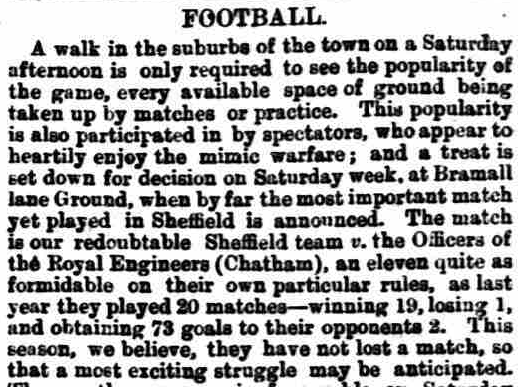
The Officers of The Royal Engineers, Chatham. A formidable outfit, early advocates of combination play, pioneers of the pyramid formation that dominated the game for 50 years.
In 1871-72 they were reckoned (according to contemporary reports) to have lost only 1 out of 20 games played (which would have been the FA Cup final), scoring 73 and conceding only 2. The central figure in this group is Francis Marindin.
The Royal Engineers team was made up of officers- in the 1872 and 1875 Cup Finals 2 Captains and 9 Lieutenants, 1874 a Major (Marindin) a Captain and 9 Lieutenants, 1878 11 Lieutenants.
Poignantly the Royal Engineers' last FA Cup campaign came in the watershed season of 1882-83 when the Cup went north for the first time.


22.2.14

Officers of The Royal Engineers (Chatham) on Tour


In December 1873 the Royal Engineers went on tour to Sheffield and the Midlands. The Engineers team were all serving officers and the tour was arranged around periods of leave.
The three games played are often credited with introducing the Combination Game to a wider audience.
Although the exact origins of a systematic approach to playing association football in concert with one's team mates is very difficult to pin down, but documentary evidence supports the deployment of such tactics by the Engineers from the late 1860s, predating the culture shock of the 1872 England Scotland international in which the 11 Queen's Park players used tactics that were supposedly completely alien to the English. 


Sheffield and Rotherham Independent 09.12.73


The Sheffield Daily Telegraph 22.12.73

The Engineers were an adaptable lot- they were not averse to playing Sheffield rules (they went as far as playing Rugby rules on occasions). Note the reference to the throw in and the Sheffield reporters preference for the kick in. I remember a similar debate re surfacing in the 1980s!
The Sheffield FA team who played against Glasgow in the 1870s were in turn praised and damned for using a combination game unusual among English sides. 
The Mr Owen referred to is Rev. John Robert Blayney Owen. He later played for England. Owen was at Trent College and would have turned out for Derbyshire had it not been for the injury he sustained in the match at Sheffield. 
H.W Renny-Tailyour was injured for the Sheffield game, which he umpired. He returned for the Derbyshire game. 

The Derbyshire Times 24.12.73

A capital luncheon- before the match, and a splendid banquet afterwards.  It is implied that a different set of rules was employed in each half of the Derby game. 

The Standard 26.12.73
Nottingham Forest had been in existence since 1865. Their splendidly Dickensian named captain, Samuel Weller Widdowson, known as the inventor of shinguards, was impressed by the Engineers' use of a pyramid formation. During the course of the nest decade this became standard throughout Association Football.


20.12.73
Sheffield Association
0
4
Royal Engineers
Bramall Lane


Rawson, Van Donop, Olivier (2)

c 3,000
22.12.73
Derbyshire
1
2
Royal Engineers
South
Derbyshire CC

Gadsby


Rawson, Van Donop

23.12.73
Nottingham Forest
1
2
Royal Engineers
Trent Bridge

Spencer


Van Donop, Ellis


17.1.13

Presidents of the Football Association

Arthur Pember (1863-1867)

Arthur Pember was present at the founding of the Football Association as a representative of N.N. Kilburn (usually explained as No Names)- he was also a member of Wanderers. Away from football Pember was a journalist of renown,  working mainly in the USA.

Ebenezer Cobb Morley (1867-74)

The Football Association's first secretary, Morley was from Kingston upon Hull, but moved to London in his twenties and played for Barnes. Morley wrote a letter to Bell's Life proposing that football needed a governing body to codify the rules. This led to the foundation of the FA. It was Morley who wrote the first draft of The Laws of The Game.
Morley played for Barnes against Richmond in the first ever game played under the 1863 rules and also represented London against Sheffield in 1866.

Colonel Sir Francis Arthur Marindin (1874-1890)

Marindin played in 2 FA Cup Finals for Royal Engineers and, in his capacity as president of the FA, acted as referee in 9 finals. . Despite this involvement in the game when it was rapidly evolving , when Marindin died in 1900 his obituary in The Times made no reference whatsoever to football.


Lord Kinnaird (1890-1923)

Lord Kinnaird had played in 9 FA Cup Finals (plus two replays), and was on the winning side 5 times.In 1873 he represented Scotland against England at The Oval, having earlier played in 3 of  the unofficial meetings between England and Scotland XIs in 1870-71. Lord Kinnaird passed away shortly before the opening of The Empire Stadium Wembley, having been President of the FA for 33 years.

Sir John Charles Clegg

Sir J.C Clegg was Sheffield through and through. He was a member of Sheffield F.C and represented Sheffield Association in a match against the FA in 1871 when Sheffield football was still a distinct game from the association code.  He competed in the first international match between England and Scotland in 1872- he reported feeling somewhat left out by his 'snobbish' southern teammates. Later a prominent referee (taking charge of the 1892 FA Cup Final) and Chairman of The Wednesday. He had a lifelong distaste for professionalism. During his tenure as FA president (he had been chairman from 1890)  Sir John became known as the Napoleon of Football.

28.8.12

Francis Marindin

The Major
 Francis Marindin  was a captain in the Royal Engineers when he played in the first FA Cup Final in 1872. He appeared in the final again  in 1874, but was on the losing side both times.
Marindin had been responsible for founding the Royal Engineers club, who were to the forefront of the move from individualistic play to the Combination Game based on passing.
'The Majaw' went on to become a highly respected referee,and also felt that it was appropriate to his position as chairman of the Football Association to take charge of the most prestigious matches. Consequently from 1880 to 1890 he refereed 9 FA Cup finals.
 Marindin disapproved of the advent of professionalism and the use of Scottish players by the northern professional clubs. For this reason he congratulated West Bromwich Albion after a cup semi final win over Preston in 1887 (a game that he had refereed) and told them that he hoped they would win the final (in which he also officiated!) . They didn't though, they lost to a slightly Scottish flavoured Aston Villa.

During The Major's 18 year involvement in the FA Cup it moved from being a minority diversion for amateurs (the 1872 final watched by 2000) to a mass spectator sport increasingly dominated by professionals 
(20,000 watched The Major's last final in 1890, in which Blackburn Rovers beat The Wednesday 6-1).
Note: during his career Marindin would have adjudicated from the touchlines- the referee only 'entered the field of play' in 1891.