Showing posts with label World Cup. Show all posts

12.10.18

A goal by Pablo Dorado


As I've written before, if I had a time machine I think the first football match I would go and watch would be the 1930 World Cup Final.

In the 12th minute 22 year old outside right Pablo Dorado of Club Atlético Bella Vista fired through the legs of Bottaso at his near post. 1-0 to Uruguay.

27.10.17

Italy 1934


1934 was year 12 (XII) of the fascist era in Italy and the visual language of fascism figured strongly in the presentation of the tournament.
The monumental player (who is reminiscent of Il Duce himself) stands with his arm raised, on a pedestal that features a fasces-like object.
There was no way that Italy were not going to win the World Cup in 1934. They benefited from some dubious refereeing. The shame is that this detracted from the real qualities of the players and the genius of coach Vittorio Pozzo and his innovative Metodo.


17.9.17

Spain vs Brazil 1934


The knockout format of the 1934 World Cup tournament meant that Brazil, Argentina and the United States only played one match each after their transatlantic voyages.
Here is an action shot from the Brazil v Spain match played at Stadio Luigi Ferraris, Genoa (27.05.34). Leônidas da Silva shooting wide, watched by Ricardo Zamora.
Brazil were 3-0 down in half an hour, Leônidas announced himself with a 55th minute strike. Brazil were awarded a penalty in the 62nd minute, but Zamora, playing in his 43rd international, saved from Waldemar de Brito.


27.8.17

Estadio Centenario

Estadio Centenario, Montevideo.
A super stadium purpose built for the 1930 FIFA World Cup.
The stands commemorated the triumphs of Uruguay's Golden Decade (Amsterdam, Colombes, Olympic).
Originally the plan was to hold all 18 matches at Estadio Centenario, but in the event games were also played at Estadio Gran Parque Central and Estadio Pocitos. Centenario hosted 10 games, which yielded 44 goals.
The stadium was capable of accommodating 90,000 spectators. The official attendance for the final was 68,346, 11,500 less than attended the semi final of Uruguay vs Yugoslavia.
The diagram has the pitch divided into squares as a means of helping radio listeners keep track of where the action was (a system pioneered by BBC commentators). 


2.5.17

José Laguna

Image result 


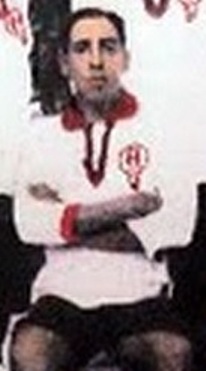
José Durand Laguna, known as 'El Negro', was a prolific forward for Huracán. 
He represented Argentina 4 times, scoring 3 goals.
His debut came in unusual circumstances. At the 1916 South American Championship of Nations Laguna went to watch the Argentina vs Brazil game at Gimnasia y Esgrima in Buenos Aires (10.07.16).
Alberto Ohaco was unable to play and Laguna was called from the stand to fill the vacancy. 
He gave Argentina the lead in the 10th minute. The game finished 1-1.
Laguna later moved to Paraguay where he played for Olimpia. He also managed the Paraguay national side at 2 South American Championships and the 1930 World Cup.


16.2.17

1934 World Cup-Team of the Tournament


Ricardo Zamora (Spain)
Often cited as the greatest goalkeeper of his generation, 33 year old Zamora was playing for Madrid at the time of the 1934 finals. Spain played 2 matches in the tournament, winning one.
An interesting choice considering that 2 other legendary goalkeepers,
Gianpiero Combi and František Plánička went on to the final, both as captains.


Jacinto Quincoces (Spain)
The 29 year old Madrid defender was usually deployed in the central 'stopper' position. 


Eraldo Monzeglio (Italy)
27 year old Monzeglio of Bologna went on to be a double World Cup winner, representing Italy 35 times.


Luis Monti (Italy)
The 33 year old Juventus half back had featured in the 1930 Team of the Tournament when representing his native Argentina.


Attilio Ferraris (Italy)
The 30 year old played for Roma at the time of the World Cup win.


Leonardo Cilaurren (Spain)
21 year old  Cilaurren played for Athletic Bilbao. 

Giuseppe Meazza (Italy)
The 23 year old Ambrosiana player had already won 22 international caps by the time the 1934 World Cup came around. He went on to represent Italy 53 times and is one of the true all time greats.


Raimundo Orsi (Italy)
Born in Argentina, 32 year old Orsi of Juventus scored 3 goals at the finals, including Italy's opening goal in the final.


Enrique Guaita (Italy)
23 year old Guaita was another of the Orundi. A Roma player at the time of the World Cup victory, he scored 1 goal in the finals.


Matthias Sindelar (Austria)
31 year old  Sindelar (Austria Vienna) scored 1 goal at the finals. Austria were semi-finalists, losing to Italy.

Oldřich Nejedlý (Czechoslovakia)
The 24 year old Sparta Prague inside left won the Golden Boot with 5 goals, including a hat trick in the semi final. 


16.1.17

1930


Gold medals from the 1930 World Cup. These were presented to Hector Scarone and Jose Leandro Andrade. The 18 carat medals measure 4cm x 2cm and weigh 25 grammes.
The Uruguayan Football Association also presented the players with replicas of the Trophy 'Victory', later named in honour of Jules Rimet.


This model was the property of Uruguay captain, Jose Nasazzi.


2.1.17

Primer Campeonato Mundial de Futbol


If I had a time machine I think the first football match I would go and watch would be the 1930 World Cup Final.
This souvenir brochure was produced in a limited edition of 3,000 copies. Published by the Uruguyan Football Association the book featured 174 photographs and an account of the organization of the tournament, reports of all the matches and  FIFA's official summary.
A good copy would fetch about € 1,100 at auction.


18.11.16

Edmund Conen


Edmund Conen's career was divided into two halves; 1934-1935 and 1939-42. The Saarbrücken forward made his debut as a 19 year old, scoring twice against Hungary. His next international came at the World Cup in Italy, where he scored 3 goals in 20 minutes to give Germany victory over Belgium.
Up to September 1935 Conen played in 14 internationals, scoring 14 goals (including a further 2 hat tricks).
Conen then vanished from top class football for the best part of 4 years.
He was suffering from a mental disorder which was characterized by a somatic preoccupation with his heart, believing himself to be seriously ill.
Remarkably he recovered to go on to an equally prolific 'second' career- scoring 13 goals in 13 internationals.


14.9.16

1930 World Cup-Team of the Tournament


Enrique Ballestrero (Uruguay)
The 25 year old Rampla Juniors ‘keeper conceded 3 goals, keeping 3 clean sheets in the group stage.


José Nasazzi (Uruguay)
El Gran Mariscal was 28 at the time of the World Cup and was playing club football for Bella Vista. Already with 2 Olympic Golds and 3 South American Championships to his name, Nasazzi was the player of the tournament.


Milutin Ivković (Yugoslavia)
24-year-old medical student, captain of Yugoslavia. The only European on the list, he played for SK Soko (Belgrade).

Luis Monti (Argentina)
Doble Ancho, the 29 year old Club Atlético San Lorenzo de Almagro halfback scored 
2 goals in the tournament and was reputedly subject to death threats before the final. 


Álvaro Gestido (Uruguay)
The 23 yr old Peñarol centre half was another Olympic gold medalist (1928).

José Leandro Andrade (Uruguay)
28 year old Maravilla Negra was a Nacional player at the time of the World Cup win. He was also a double Olympic champion and 3 times South American Championship winner.

Pedro Cea (Uruguay)
The 29 year old Nacional forward scored 5 goals in the tournament including a hattrick in the semi final. He scored the goal that brought Uruguay level at 2-2 in the final. He was also a double Olympic Gold medalist.
Héctor Castro (Uruguay)
25 year old  Nacional centre forward won a Gold medal at the 1928 Olympics and was a 2 times South American Championship winner.He was Uruguay's first World Cup scorer. His second goal of the tournament was Uruguay's 4th in the final, scored in the 89th minute.
Famously Castro was an amputee.


Héctor Scarone (Uruguay)
The veteran inside forward was 31 at the time of the World Cup win. He was back at Nacional following a spell with Barcelona. Scarone had won 4 South American Championships and 2 Olympic Gold medals.
Guillermo Stábile (Argentina)
Having come in as a replacement for Argentina's second game, 25 year old Stabile (Huracan)  scored 8 goals in 4 games and never played in another international match, moving to Italy after the World Cup. 

Bert Patenaude (USA)
The 21 year old Fall River Marksmen forward is credited with 4 goals at the World Cup.


26.8.16

Modesto Denis

Goalkeepers never wear knee pads these days.
Modesto Denis represented Paraguay at 5 South American Championships and played in 1 game at the 1930 World Cup.
He played his club football with Club Nacional (Asunción), winning the national championsip in 1924 and 1926.

10.4.16

Balls


31st May 1934, Stadio Littoriale, Bologna. Before the Hungary v Austria match, the process of selecting the match ball. I believe the picture shows Sternberg László (holding the balls) and  Hans Horvath (pointing). Referee Francesco Mattea (Italy) behind Horvath and possibly  Hungary coach Nádas Ödön on the left.
We have seen that in 1930 there was controversy over which ball was used in the final. In Italy 1934 there were 3 different models of ball in use, and the teams would decide which one to use before each game. 

23.1.16

Bolivia


Paying tribute to the hosts, Bolivia before their opening game of the 1930 World Cup. Bolivia lost this match 4-0 to Yugoslavia.
Here's how they lined up:

GK
Jesús Bermúdez
Oruro Royal
FB
Segundo Durandal
Club San José
FB
Casiano Chavarría
Calavera La Paz
HB
Jorge Luis Valderrama*
Oruro Royal
HB
Diógenes Lara
Club Bolívar
HB
Juan Argote
Club Bolívar
F
Rafael Méndez
Universitario La Paz
F
Gumersindo Gómez
Oruro Royal
F
René Fernández
Alianza Oruro
F
José Bustamante
Litoral
F
Mario Alborta
Club Bolívar

* Some sources spell his name Balderrama

19.12.15

South America v Europe

From 1924-1936 there were 27 meetings between South American and European international teams.

1924
Paris Olympics.
26.05.24
Yugoslavia
0
7
Uruguay 
01.06.24   
France   
1
5
Uruguay               
06.06.24   
Netherlands
1
2  
Uruguay
09.06.24   
Switzerland   
0
3
Uruguay  

1928
Uruguay had been the only South American team at the 1924 Olympics, qualifying via the South American championships. In 1928 they were joined by Argentina (who they beat in the final) and Chile.
Argentina played a friendly on their way to the tournament:

01.04.28
Portugal
0
0
Argentina
Amsterdam Olympics
27.05.28
Portugal        
4
2
Chile
30.05.28 
Uruguay
2
0
Netherlands
02.06.28 
Belgium
3
6
Argentina
03.06.28 
Uruguay
4
1
Germany
07.06.28 
Uruguay
3
2
Italy
08.06.28 
Netherlands
2
2
Chile        
  
1930
Uruguay 1930 World Cup
14.07.30    
Romania
3
1
Peru
14.07.30 
Brazil
1
2
Yugoslavia
15.07.30      
Argentina
1
0
 France   
17.07.30  
Bolivia
0
4
Yugoslavia
19.07.30
Chile
1
0
France
20.07.30 
Paraguay
1
0
Belgium
21.07.30 
Uruguay
4
0
Romania
27.07.30
Uruguay
6
1
Yugoslavia
Post World Cup friendlies
01.08.30  
Brazil
3
2
France
03.08.30 
Argentina
3
1
Yugoslavia
10.08.30
Brazil
4
1
Yugoslavia

1934
Italy 1934 World Cup
27.05.34 
Brazil
1
3
Spain
27.05.34
Sweden
3
2
Argentina 
Post World Cup friendly
03.06.34
Yugoslavia
8
4
Brazil

1936
Germany 1936 Olympics
06.08.36    
Finland  
3
7
Peru
09.08.36   
Peru
4
2
Austria                          


Uruguay v Switzerland 1924


Yugoslavia v Brazil 1930


W
D
G
South America
18
2
79
Europe
7
47


P
W
D
L
F
A
Uruguay
9
9


36
6
Paraguay
1
1


1
0
Argentina
5
3
1
1
12
7
Brazil
5
2

3
13
16
Peru
3
2

1
12
8
Chile
3
1
1
1
5
6
Bolivia
1


1
0
4


P
W
D
L
F
A
Spain
1
1


3
1
Sweden
1
1


3
2
Yugoslavia
7
3

4
17
25
Portugal   
2
1
1

4
2
Romania
2
1

1
3
5
Netherlands
3

1
2
3
6
Italy
1


1
2
3
Switzerland   
1


1
0
3
Austria
1


1
2
4
Germany
1


1
1
4
Finland
1


1
3
7
Belgium
2


2
3
7
France   
4


4
3
10