Showing posts with label Oxford University. Show all posts

18.1.14

P.M Walters, A.M Walters, H. M. Walters


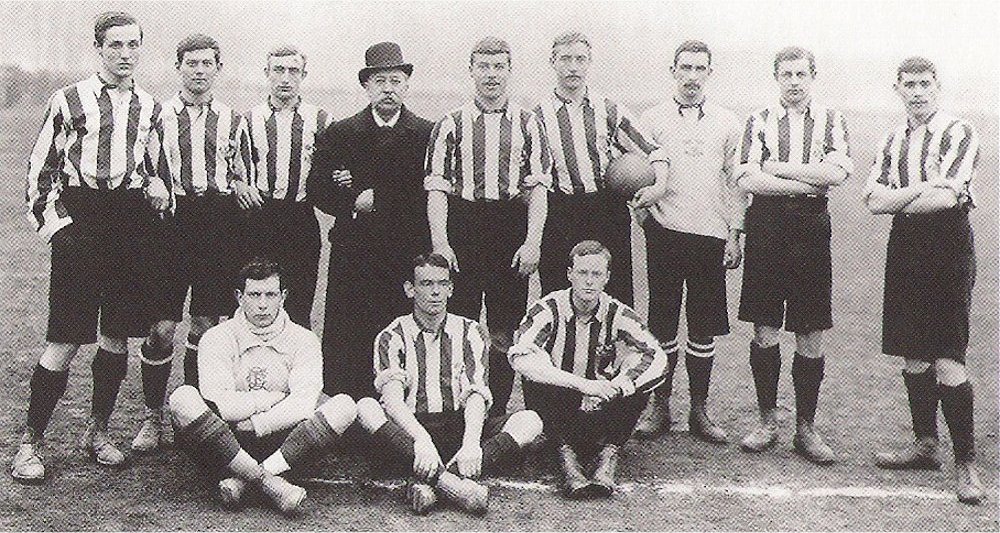
The brothers 'Morning' and 'Afternoon' Walters played together as right and left fullback for England on 9 occasions. They also played alongside each other for Old Carthusians and Corinthian FC, as well as against each other in the 1885 'Varsity Match (Percy for Oxford and Arthur Cambridge) Their international careers ended in 1890, when in response to the death of their brother and in respect of their mother's wishes, they gave up all football.
Arthur was 25 and Percy 27.
Arthur made a comeback for Corinthians in 1892-93. Percy also returned to the game,appearing in the FA Amateur Cup Final in 1895. 

The cutting records the death of H.W Walters. A forward with Casuals FC, he received a kick in the abdomen in the game against St Bartholomew's Hospital on November 12th 1890. The injury led to acute peritonitis and he died on November  27th.


2.12.12

The Varsity Match

Having being played every year since the 1873-74 season (aside from wartime interruptions 1915-19 and 1940-45) the Varsity match between the football clubs of Oxford University and Cambridge University must surely be the longest standing regular fixture in world football.
The first Varsity match, played at The Oval,  was won 1-0 by Oxford, with England international Robert Walpole Sealy Vidal scoring the only goal. (Vidal played in the first 3 FA Cup finals).
Oxford lost the 1873 FA Cup Final 2-0 to Wanderers and beat Royal Engineers by the same score in the final the following year.

 England's first ever international XI, featured Oxford players. In total 22 Oxford players have been capped by England, and 5 by Wales.
Oxford University 1874
Cambridge was noted for football in the pre association days, and in fact the Cambridge Rules of 1848 played a significant role in the development of the Football Association's rules of 1863.  In the words of C.W. Alcock:
The Cambridge Rules appear to be the most desirable for the Association to adopt...

This influence is commemorated by a plaque at Cambridge University's home ground:

Here on Parker's Piece, in the 1800s, students established a common set of simple football rules emphasising skill above force, which forbade catching the ball and 'hacking'. These 'Cambridge Rules' became the defining influence on the 1863 Football Association rules

The Light Blues also had a significant influence on the way in which the game developed tactically, with references being made to them playing a 'combination game ' as early as the 1870's. They were also early exponents of a pyramid system (2-3-5):


The Cambridge University eleven of 1883 were the first to illustrate the full possibilities of a systematic combination giving full scope to the defence as well as the attack...
C.W. Alcock The English Illustrated Magazine (1891)
24 Cambridge players represented England, including 5 in the same match against Scotland in March 1886.


An Oxford v Cambridge game at the Queens Club in the early 20th century.


Table of results- 1874-1937*


1
2
3
4
5
6
7
8
9
1870


1880


1890


1900


1910


1920


1930


 *
 *


Dark Blue- Oxford (26 wins- most consecutive wins=4)
Light Blue- Cambridge (22 wins- most consecutive wins=5)
Red- Draw (9)
Black- No fixture 
* our coverage of football history ends in the summer of 1937

Oxford and Cambridge also featured in the early years of the FA Cup. Oxford were the more successful of the two, reaching the final 4 times, lifting the Cup once.


Year
Oxford
Cambridge
1871-72


1872-73
Runners-up

1873-74
Winners
2nd round
1874-75
Semi Final
2nd round
1875-76
Semi Final
3rd round*
1876-77
Runners-up
Semi Final
1877-78
4th round
3rd round
1878-79
4th round
3rd round
1879-80
Runners-up
1st round

*In 1875-76 season the two were drawn together in the 3rd round.  On 31st January 1876 at Cambridge, Oxford won by 4-0. This does not count as a Varsity match as such. Six weeks previously Oxford had won the 1875 Varsity match 4-1.

4.9.12

Oxford University - Tour of Austria 1899


Football was introduced to  Austria in the mid-1890's by the English community in Vienna.
The Austrian Football Association, (Comité zur Veranstaltung von Fußballwettspielen), was founded in 1898 by Mark Nicholson, a former West Bromwich Albion professional.
In 1899  the Vienna Cricket & Football Club invited Oxford University AFC to play in Austria.


The tour began in Prague on March 28th. Oxford played Slavia Prague on the day of their arrival.  Slavia were considered the strongest team on the continent; Oxford beat them 3-0. The next day they beat DFC Prague 9-0.
On 1st April  the team arrived in Vienna.
The Vienna Cricket & Football Club honoured them with a banquet, with Mark Twain amongst the guests.
On 2nd April  Oxford University AFC beat a select team of Vienna-born players 15-0 at the WAC-Platz.
The following day, at the same ground, they beat a combined Viennese and  English team 13-0.

11.8.12

Cuthbert Ottaway (England, 1872 -1874)

His beautiful science exhibited how a ball ought to be taken through a host of foes.

Cuthbert Ottaway was the first ever England captain, in the game against Scotland on 30th November 1872. He also led England to a 2-1 defeat at Partick in the third international on 7th March 1874. These were his only 2 caps.
Ottaway, who was an accomplished cricketer and all round sportsman represented  Old EtoniansOxford UniversityCrystal Palace and Marlow.
He played in three successive FA Cup finals from 1873 to 1875, losing 1-2 with Oxford University against Wanderers in 1873, winning 2-0 with Oxford University against Royal Engineers a year later, and then representing Old Etonians against Royal Engineers in 1875. Ottaway sustained an ankle injury in the first half of the drawn 1875 final. He left the field and was not fit for the replay.  In fact there is no evidence that he ever played senior football again after this match.
He died in 1878, aged 27.