Showing posts with label Central America and Caribbean. Show all posts

10.9.13

Martinez Shield


Trinidad 1936

Britain gave the world football, but as we have seen, her own colonies did not embrace it to the extent that they became significant powers in football, or even play the game as their national sport.
To British minds the Caribbean will always be more associated with cricket.
There was, however, throughout the colonies in The West Indies, a healthy interest in the association game. 
An international match was played between Trinidad & Tobago and  British Guiana (sic) as early as 1905.  regular internationals did not come to the area until the 1920s.
To quote the press of the day an 'Intercolonial Football Tourney' was introduced in 1923. This was the Martinez Shield. 

As a result of arrangements between the Association and the sister Colonies of Demerara and Barbados it is likely that this year will mark the institution of Intercolonial Football between the Colonies.
Trinidad Guardian 01.07.23

The first tournament was played in Trinidad in 1923. Barbados were unable to make it, infact Trinidad and Demerara were the sole contenders for the first 5 editions of the shield. They played 3 matches:

Trinidad  1-1  Demerara
Trinidad  1-0  Demerara
Trinidad  2-0  Demerara

The Martinez Shield was next contested in Demerara in 1925, Trinidad retaining the trophy by winning 2 games to the hosts' 1. 


Another  3 match series back at Trinidad in 1926 saw Trinidad winning 2, with one draw.  In 1928 Trinidad made it 4 in a row,  again winning 2 games to 1 in Demerara. 

Demerara first won the Martinez Shield in 1929. A 5 game series in Trinidad went as follows: 

Trinidad  0-0  Demerara
Trinidad  0-1  Demerara
Trinidad  3-1  Demerara
Trinidad  1-1  Demerara
Trinidad  0-1  Demerara

The Shield finally became a triangular tournament in 1931. Hosts Demerara retained the trophy, whilst new boys Barbados took some heavy beatings. Test Cricketer Ellis Achong was in the Trinidad side, and scored plenty of goals:  


Trinidad  7-1  Barbados
Demerara  1-1  Trinidad
Demerara  9-0  Barbados
Trinidad  5-1  Barbados
Demerara  7-0  Barbados
Demerara  2-0  Trinidad

P
W
D
L
F
A
Pts
Demerara    
4
3
1
0
19
1
7
Trinidad    
4
2
1
1
13
5
5
Barbados
4
0
0
4
2
28
0

The following year the Shield was contested in Barbados. Demerara were the winners for the third time in succession, but Barbados were greatly improved, beating Trinidad and drawing with Demerara:

Demerara  1-0  Trinidad
Barbados  1-0  Trinidad
Barbados  0-1  Demerara
Barbados  2-2  Demerara
Trinidad  2-1  Demerara 
Barbados  1-3  Trinidad


P
W
D
L
F
A
Pts
Demerara    
4
2
1
1
5
4
5
Trinidad    
4
2
0
2
5
4
4
Barbados
4
1
1
2
4
6
3

In 1933 Trinidad returned to their winning ways in front of a home crowd:

Barbados  0-2  Demerara
Trinidad  1-1  Demerara
Trinidad  3-1  Ba rbados 
Trinidad  1-0  Demerara 
Demerara  5-2  Barbados
Trinidad  6-0  Barbados


P
W
D
L
F
A
Pts
Trinidad  
4
3
1
0
11
2
7
Demerara  
4
2
1
1
8
4
5
Barbados
4
0
0
4
3
13
0

4.9.13

Haiti

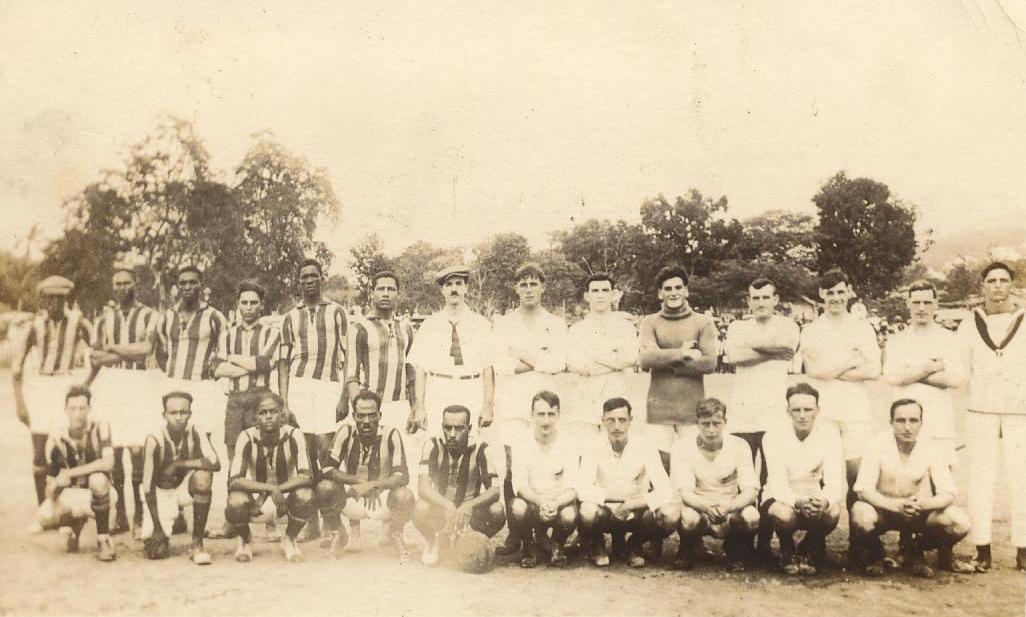
HMS Curlew - football team v Haitians at Port au Prince, 1924

The photograph shows the crew team of HMS Curlew, a light cruiser of the Royal Navy, about to play a match in  Port au Prince on March 8th 1924. In July that year Curlew went to Brazil, but not for football, but to intercede in a rebellion. 
The Haitian team are identified simply as Haitians.
One of the principal teams in Port au Prince , Violette Athletic Club (founded in 1918), plays in blue and whirte stripes, and Racing Club Haïtien (founded 1923) also wear stripes in some early photographs. 
There is a possibility, however, that the team were a proto national side. Early pictures of the national team, who played their first international in March 1925 (against Jamaica) , show that they, too, sported striped jerseys. 
Domestic histories are sketchy, but there is evidence of a Haitian championship as early as 1912 and a cup competition in 1927.  
 Fédération Haïtienne de Football dates from 1904, and the country attained FIFA affiliation in 1933.

Acknowledgements to Mr Gordon Smith at http://www.naval-history.net/

30.6.13

Cuba

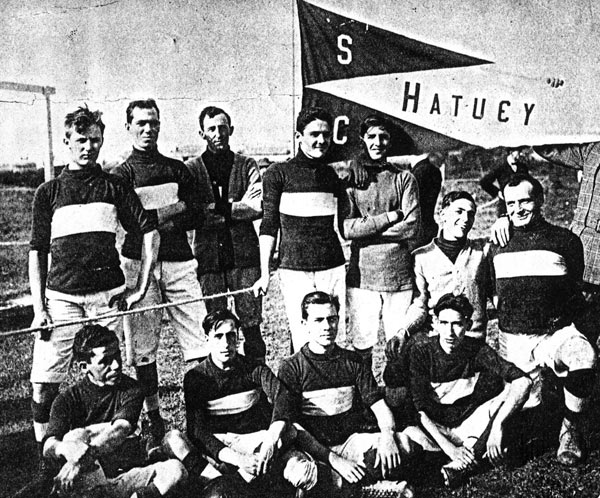
 SC Hatüey
Soccer is a relatively minor sport in modern Cuba. The socialist republic, which has resisted in so many ways the malign influence of it's near neighbour the USA, has embraced American sports.
The first football club in Cuba was SC Hatüey, founded in 1907. The  Havana based club took their name from an indigenous chief who had resisted Spanish colonization. The name of the club is usually given with the Spanish prefix CD (Club Deportes) but as the contemporary banner shows, they used the Anglicized SC (sports club).
In 1909 Britons resident in Havana created the Rovers Athletic Club. The two clubs did not meet for a further 2 years. In the meantime however in February 1910 Hatüey played a match against a team of British sailors and won 8-0.
In December 1911 SC Hatüey  and Rovers AC met for the first official match  in the history of Cuban football. Hatüey were a Cuban club, whereas Rovers was composed of British expatriates. It was the first encounter in a 4 team league. Rovers won 1-0 thanks to a goal from founder Jack C. Orr. Some of the results are lost to posterity. Rovers AC, however, were the national champions in that inaugural season (1912). the other teams in the league were CD Hispano-América and  Euskeria SC.
The Cuban Football Association  was founded in 1924 and Cuba joined FIFA in 1929.

National champions:

 1912 Rovers AC 
 1913 SC Hatüey
 1914 Rovers AC
 1915 Hispano América 
 1916 La Habana FC 
 1917 Iberia 
 1918 Iberia 
 1919 Hispano América 
 1920 Hispano América 
 1921 Hispano América 
 1922 Iberia 
 1923 Iberia 
 1924 Olimpia 
 1925 Fortuna 
 1926 Real Iberia 
 1927 Juventud Asturiana 
 1928 Real Iberia 
 1929 Real Iberia 
 1930 Deportivo Español 
 1931 DC Gallego 
 1932 DC Gallego 
 1933 Juventud Asturiana 
 1934 Real Iberia 
 1935 Juventud Asturiana 
 1936 Juventud Asturiana 
 1937 DC Gallego

Internationals:

In 1930 a Cuba representative XI played Real Sociedad, losing 7-1. 


Cuba entered international football whern Havana hosted the 1930 Central American and Caribbean Games.
16.03.30     Cuba    3-1  Jamaica
20.03.30     Cuba    7-0  Honduras 
23.03.30     Cuba    5-0  Honduras
30.03.30     Cuba    2-1  Costa Rica         
01.04.30     Cuba    5-2  El Salvador        
This sequence of results secured the gold medal for Cuba. 

Cuba entered the 1934 World Cup. They played a series of matches with Haiti for the right to face Mexico. The winners of the Mexico v Cuba series would play the USA for a place in the finals. 
28.01.34      Haiti    1-3  Cuba  
01.02.34      Haiti    1-1  Cuba      
04.02.34      Haiti    0-6  Cuba      
04.03.34     Mexico  3-2  Cuba 
11.03.34     Mexico  5-0  Cuba   
18.03.34     Mexico  4-1  Cuba 

Cuba's next batch of international fixtures came at  the 1935 Central American and Caribbean Games in San SalvadorEl Salvador. On this occasion Cuba could only manage bronze, sharing 3rd place with  El Salvador.
24.03.35     El Salvador   4-1  Cuba (El Salvador)        
25.03.35     Cuba   3-0    Honduras (El Salvador)        
27.03.35     Cuba   2-1    Guatemala (El Salvador)        
30.03.35     Cuba   1-6    Mexico   (El Salvador)           
31.03.35     Cuba   1-2    Costa Rica (El Salvador) 


17.3.13

Mexico


When looking at the early days of Mexican international football we will find that Rafael Garza Gutiérrez (known popularly as Record) occupies centre stage.

Record was a founder of América (1916), the club which in 1922 became the first Mexican team to play abroad, taking part in a tournament in Guatemala.
América also figured large on the domestic front, being league champions 4 seasons in a row (1924-25 to 1927-28).
Garza Gutiérrez was a natural choice to lead Mexico.
Mexico's first 6 internationals were all played against Guatemala in 1923, 3 in Guatemala in January and 3 in Mexico City in December. Following this series of matches there was a 5 year hiatus -Mexico's next match being at the Amsterdam Olympics. In the meantime the Federación Mexicana de Fútbol Asociación had been formed (1927). 

Here we will look at the first three internationals, all played on a tour of Guatemala in January 1923. The Mexican squad was made up entirely of América players:
Ignacio de la Garza 
Pedro Legarreta 
Rafael Garza Gutiérrez "Record"(c)
Enrique Esquivel 
José Andrade 
Pablo Sarré 
Carlos Garcés 
Horacio Ortíz 
José Díaz Izquierdo 
Adeodato López 
Humberto Garza Ramos 
Agustín Ojeda  replaced Humberto Garza Ramos for the second game only.The team was managed by Adolfo Frías Beltrán.

Guatemala had previous experience of international football, havingh played 2 matches in September 1921 in which they beat Honduras 9-0 and lost 6-0 to Costa Rica.


1. 01.01.23  Guatemala 2-3 México
(Campo Marte, Guatemala: 10,000)
José Díaz Izquierdo scored Mexico's first international goal to put them 1-0 up in the 26th minute. Horacio Ortíz added a second before half time. 

Fernando Minondo scored for Guatemala on 65. Adeodato López extended Mexico's lead in the 70th minute and Constantino Kinhie got the hosts' second 2 minutes later.


2.04.01.23 Guatemala 3-1 México
(Campo Marte, Guatemala: 10,000)
Three days later Guatemala exacted some revenge on the visitors. José Minondo struck twice in the first half and completed his hattrick after Horacio Ortíz had pulled one back for Mexico.

3. 07.01.23 Guatemala 1-4 México
(Campo Marte, Guatemala: 6,000)
Mexico got off to a flying start in the third match, with José Díaz Izquierdo and Horacio Ortíz scoring in the opening 10 minutes. Adeodato López got the third in the 34th minute and completed the scoring 6 minutes from time. José Minondo had scored for the hosts in the 68th minute. 

Garza Gutiérrez later led Mexico in the 1928 Olympics and the 1930 World Cup. On retiring as a player he became the manager of the national team.

31.10.12

Football in Trinidad and Tobago

Casuals FC


TO-DAY will mark the beginning of a new era in the history of sport when the first football match in the League competition which will be contested by the Casuals and Clydesdale teams, which are admittedly the strongest combinations in the local world of football. The recent formation of an Amateur Football Association among the various football clubs in the colony has certainly created greater popular interest in that form of outdoor sport, while tending in itself to lift the game to a higher standard of efficiency by means of open competition in league matches between the respective football units. The cricket season has practically closed and for the next three months, football will be the centre of attraction of our sport-loving community. Strictly speaking, football is more or less in its infancy in this colony, but with the practical sympathy and general interest which it has already awakened, there is evidence that in the not distant future, the game will take that high position in the arena of local sport to which its peculiar attractions so fully entitle it. To-day's game which will be played on "Casuals" ground, will start at 5 p.m. punctually with the formality of the "kicking off" of the ball by the President of the Association; preparatory to which, at five minutes before call of time, the teams will be lined up at their respective goals. The players are requested to turn up at 4.45 p.m., so as to avoid delay in starting. Ample seating accommodation will be made for ladies attending. The teams are as follows:—
CASUALS—(Colours: Maroon and White). Linesman, Mr. T. Jackson. Goal, E.M. Legge; Backs, D. M. Anderson, F. N. Brierly, (capt.); Half-Backs, N. Farian, A. McCracken, R. Johnstone; Forwards, W. H. Eccles, G. D. Owen, J. R. Rochford, Revd. W. E. Smith, G. A. Brierly. Reserves, B. Athill, E. Sanderson.
CLYDESDALE—(Colours: Black and White). Linesman, Mr. A. B. Knowles. Goal, J. B. Todd; Backs, J. Penrich (capt.), J. Simpson; Half-Backs, C. Thavenot, J. H. Hoadley, W. Adam; Forwards, G. Logie, H. Bullock, H. W. Knox, P. Taylor, Wm. Stewart. Reserves, A. H. Cochrane, H. Ewalt.
Mr. Felix Leotaud will be the Referee.
Port-of-Spain Gazette 19.9.08