8.8.12

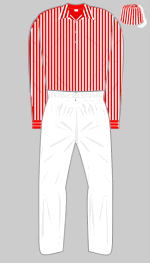
Andrew Watson, Scotland 1881


In 1881 Andrew Watson of Scotland became the first black international footballer. 
Born in British Guiana, the son of a Scottish sugar plantation owner and a Guianan woman, he studied at the University of Glasgow. 
Watson's three internationals were resounding successes for Scotland. In 1881 England were beaten 6-1 at the Oval and Wales were beaten 5-1 at Acton Park. The following season Scotland beat England 5-1 in  Glasgow.
Watson was a full back, and played most of his football for Queen's Park, although he did have spells with London Swifts and Corinthians whilst living in England. When playing for Swifts he became the first black player to play in the  FA Cup (1882).

7.8.12

The growth of International Football- 1901


Steve Bloomer scores against Scotland

1901

 23.2.01   Scotland 11-0 Ireland     (Celtic Park Glasgow)  
  2 .3.01   Wales 1-1 Scotland        (Racecourse Ground Wrexham)
   9.3.01   England 3-0 Ireland        (The Dell Southampton) 
 18.3.01   England 6-0 Wales         (St James' Park Newcastle) 
 23.3.01   Ireland 0-1 Wales           (Solitude, Belfast)
 30.3.01    England 2-2 Scotland     (Crystal Palace, London)

In 1901 only six international matches were played, between four teams- The British Home Championship. 
At the time the Home Nations were the only teams playing what are now recognized by FIFA  as full internationals.
During the course of the decade that number would swell to 19, and in 1910 30  full international matches would be played.
In this series of posts we will look at this growth on a year by year basis. 

India

It probably says something of the nature of imperialism that the countries of the British Empire have flourished in the sports of cricket and Rugby Union  rather than the Association game. 

India is not a nation that one readily associates with football. It is, however, the home of two of the oldest competitions in world football.


Nagendra Prasad Sarbadhikary introduced the game to India in 1877, founding a club at Hare School in Calcutta (Kolkata).

In 1888 The Durand Cup was introduced- a tournament for British Army teams. The Royal Scots Fusiliers won the inaugural Durand cup  at Simla, beating  the Highland Light Infantry  2-1. The competition effectively  became the Indian domestic cup after World War 2. During the period we cover it was a very British affair.

The Indian Football Association was formed in 1893, and the first edition of the IFA Shield was played that year. 

Early Indian football was dominated by colonists, and the first IFA shield was won by The Royal Irish Rifles.


Barefoot- Mohun Bagan, 1911.

In the 1911 IFA Shield tournament final Mohun Bagan defeated the East Yorkshire Regiment. In front of a reputed 80000, Mohun Bagan  became the first Indian winners of the Shield, and probably the first Indian (or Asian) team to defeat European opponents.


Calcutta Football League, which kicked off in 1898, is the oldest league in Asia. The Gloucestershire regiment won the first title. Calcutta FC won in 1899 and in the seasons up to 1937 British military outfits won the league 29 times, punctuated by 8 Calcutta FC wins.  In 1934 Mohammedan Sporting Club began a 5 season sequence of wins. 

6.8.12

FA Cup Final 1933


This is a charming London Underground poster by the French artist Andre Edouard Marty (1882- 1974). 

The Cup Final in question was the 1933 FA Cup final, in which a crowd of 92950 saw Everton beat Manchester City 3-0. Everton legend Dixie Dean captained the team that he had a major part in selecting. He also scored Everton's second goal. 
 The competition rules required both teams to change strip in the case of a colour clash, so Everton wore white and City deep red. Shirts were numbered for the first time in an FA Cup final, but not in the way that became familiar- in this case Everton wore 1-11 and City 12-22. Matt Busby played right half for City.

The Founder Members of The Football Association 1863

Barnes (London) participated in the first ever match under FA rules, a 0-0 draw against Richmond (who were not FA members). They also competed in the first ever FA Cup and continued to do so through to the 1885–86 competition. Switched to Rugby Football.


Blackheath FC (London) founded in 1858, is the oldest open rugby club in the world. Withdrew from the FA in protest at the proscription of 'hacking', concentrating on Rugby Football.
Blackheath Proprietary School (London) were also in on the foundation of the FA.


Civil Service F.C.  (London)  another club who played both Association and Rugby Football- when the rift over the rules led to other clubs focusing on Rugby, Civil Service continued in both codes. Literally ambassadors of the game, playing fixtures overseas.


Crusaders F.C.  (London) the club continued to play in the FA Cup into the 1880's, but I cannot find any more information about them.


Surbiton (London) - of which I know nothing.
Crystal Palace F.C (London) - not the Crystal Palace who still grace the Football League. This club was formed by groundskeepers at the Great Exhibition site at Hyde Park and lasted from 1861-1876.


Leytonstone Forest (Leytonstone, Essex) - also known as Forest FC,  the ex public schools club that evolved into The Wanderers. 


N.N. Club or N.N. Kilburn (London) -  The No- Names provided the FA with its first president, Arthur Pember.
 Kensington School (London) -  a school that favoured 'dribbling' types of football (like Eton and Charterhouse) over the carrying game (Rugby)
Perceval House (London) a school from Blackheath who also favoured the 'hacking and handling' route. After leaving the FA in December 1863 they vanish from history.


5.8.12

Alfred Lyttelton (England, 1878)


Reading descriptions of the play of The Hon.Alfred Lyttelton K.C (Cambridge University,  Old Etonians and England) nicely illustrates the fundamental differences between the early Association game and the game we know now.
In fact, Lyttelton (the first man to be capped by England in Football and cricket) provides us with early evidence of a player's strengths falling from fashion. An individualistic dribbler, he was criticized for selfish play on his one England appearance (he scored in a 3- 1 defeat to Scotland in 1878). 
Tributes were also paid to his 'bunting' skills. This 'bunting' appears to resemble the method used by a centre in Rugby Union to break through tackles:
This ... faculty he exercised by dint of a jerk of his hips, not as ordinarily by lowering the shoulder, and so the aggressor could see no sign of the terrific impact coming. 
Edward Lyttelton

What is described here is a more physical game, almost a collision sport. You dribble with the ball, probably backed up by a 'rush' of your own players surrounding you protectively. The opposition attempt to barge you off the ball, and you counter this with your own, hopefully more robust 'bunt'.

Some qualities , though, are enduring. Here isLyttelton's brother's account of his speed and shooting prowess:
He would run towards the corner and then swiftly turn inwards, running parallel to the back line, and some ten yards from it. At this point he was pursued probably by three of the opponents, barely keeping up. This continued till he got opposite the further goal post, and then one huge foot was smartly dropped on the ball, stopping it dead, and of course the pursuers all ran a yard or so too far, not suspecting the sudden pull up; thus he had a clear shot at the goal.


4.8.12

Wanderers v Queen's Park, 1872 - 1876

On 5th March 1872 Queen's Park met Wanderers in the  FA Cup semi final at Kennington Oval. The game finished  goalless. Queen's Park, however, could not afford to travel for the replay and withdrew from the competition.


In October 1875, Wanderers travelled to Scotland for the first time to play Queen's Park. Wanderers fielded their strongest side, but were beaten 5-0.A look at the programme above reveals the sophistication of Queen's Park in relation to their opponents.
Queen's Park effectively lined up 2-2-3-3, whereas Wanderers still had a primitive 1-2-7 set up. This reflects the way in which  Queen's Park  relied on purposeful passing and back up.
The London club gained its revenge four months later, however, when Queen's Park travelled to London for a re-match and lost 2–0. This was the first match the Glasgow club had lost in their 9 year history.

3.8.12

Kiev v KFS Moscow 1912


There is no evidence of these teams playing each other in the Russian Championship (City Selections) 1912-1913 so I'm assuming that this was a friendly.

36-0

 In 19th century football, mismatches were commonplace, especially in cup competitions, where scratch and amateur teams could find themselves pitted against first class opposition.
On 12th September 1885 Harp (of Dundee) hosted Aberdeen Rovers in a Scottish Cup tie. The official result is recorded as Harp 35 Aberdeen Rovers 0*. The referee recorded 37 goals, but Harp's secretary recorded only 35, and the lower total was agreed on.
Dundee Harp full back Tom O'Kane was an ex-Arbroath player, and persuaded the Dundee club's officials to send a telegram to his former colleagues at Gayfield Park boasting of his team's record breaking score.

The telegram was received with some amusement by the players and officials of Arbroath FC, because they had just completed their first round match against Bon Accord (actually Orion Cricket Club of Aberdeen, who had received an invitation to compete in the Cup in error**) and run out 36-0 winners.
Again, more goals were probably scored, and John 'Jock' Petrie set a personal record of 13 goals in the game which has never been bettered.
It goes without saying that the two goalkeepers had very different experiences, Milne not touching the ball and borrowing an umbrella from the crowd, whilst Lornie, a 22yr old  tinsmith and gas fitter,was setting a standard of unparalleled misery between the sticks at the opposite end.


12.9.1885                                              Arbroath 36 – 0 Bon Accord 
Gayfield Park, Arbroath.

Arbroath: Milne Snr, Collie, Salmond, Rennie, Milne Jr, Bruce, Petrie, Tackett, Marshall, Crawford, Neil.

Bon Accord:  Lornie, Donaghue, Connell, Keeley, Whelan, Lowrie, Sutty, Doherty, Behan, Conorson, MacManus


*undaunted Aberdeen Rovers entered the cup again in 1887 when, after a first round bye the were beaten 10-0 by Dundee  Wanderers.
**Two years later, on 3rd September 1887, Arbroath played against the 'real' Orion F.C. in the Scottish Cup and won 20–0.

1.8.12

Argentine Association Football League 1891

British sport and games tend to physically develop the youth of the country and to impose an admiration for that fair play which sport breeds.
The Standard  (Buenos Aires English-language newspaper)

Between 1870 and 1914 six million Europeans arrived in Argentina, and with more than half settling permanently by 1914 a third of the population was foreign-born, including 30,000 British.
By 1867 there was already a large British community  in Buenos Aires,  some of whom decided to form a football team to practise the sport, founding the Buenos Aires Football Club on Thursday 9th May 1867.

Today there will be a football match at Palermo; we believe it will be the first kick ever given in Buenos Ayres, and we understand that half town will be there if the weather proves favourable. The kick at the Boca never came off owing to the floods ...
The Standard  25 May 1867

This game was cancelled due to poor weather conditions, being postponed for June 26th, when the first match in Argentine football history was played. The venue was the Buenos Aires Cricket Club's field. Both teams (of 8 players each), named Colorados and Blancos, were made up of members of the Buenos Aires Football Club.

Glaswegian schoolteacher Alexander Watson Hutton is often referred to as the father of Argentine football. Hutton first taught football at St Andrew's School in Buenos Aires in the early 1880s.In 1893 Hutton established The Argentine Association Football League.

This tournament was organized two years earlier by another, short lived, Argentine Association Football League (president, F.L. Wooley), the first football league outside Europe. Five clubs competed but only one season was ever played.

Saint Andrew's

Table:
1. Old Caledonians                   8   6   1   1     13 
2. Saint Andrew's                    8   6   1   1     13 
3. Buenos Aires and Rosario Railway  8   3   1   4     7
4. Belgrano FC                       8   2   1   5     5
5. Buenos Aires FC                   8   1   0   7     2

Playoff:

13.09.1891
Flores Polo Club.
Saint Andrew's                   3:1  Old Caledonians                  
goals: Moffatt (3)                    goal:Wilson
After extra time
Saint Andrew's:F.V.Carter;L.C.Penman;G.A.Waters;F.Francis;H.Barner;A.Buchanan;J.Caldwell;Charles Douglas Moffatt;A.Lamont;E.Morgan;J.Buchanan.
Old Caledonians: W.Gibson;M.Scott;J.Riggs;W.Angus;R.Phillips;R.Smith;H.White;J.Clark;R.Sutherland;E. L. Wilson;R.Corsner.
Referee:         J. Wilson.