18.9.14

Australian Inter Colonial Matches in the 19th Century

Prior to the Federation of Australia in 1901 there were six separate colonies (Queensland, New South Wales, Victoria,Tasmania, South Australia, and Western Australia).
Victoria had it's own local code of football rules (Victoria Rules now known as Australian Rules) codified in 1859, thus predating the Association Football (1863) , Rugby Union (1871), American 'football' (1873) and Gaelic Football (1887).
Association football was played in Tasmania, New South Wales, Victoria and Queensland from the late 1870s and early 1880s.
The first Inter Colonial matches were played in 1883. Here is an account of the first match. Note the explanation of the mode of play and the low attendance. 


FOOTBALL.
VICTORIA V. NEW SOUTH WALES.    
An intercolonial football match under the British Association rules, between teams representing Victoria and New South Wales,was played yesterday on the East Melbourne cricket-ground. This game has only quiterecently been introduced here, the chief merit claimed for it by the promoters beingthat there is less rough play than under the Victorian rules, and that its general adoption would afford the opportunity for international matches with British teams. The main principle of the game is that with the exception of the goalkeeper on either side, no player is permitted to handle either the ball or his opponents, although he maybutt the ball in an inelegant way with his head. The drop-kicking and marking, together with the skilful system of exchanging little marks that have so popularised the Victorian game, are entirely wanting.If the game is apparently less rough to an observer, the element of danger is not wanting, and when a number of players come  together, all kicking at the ball, some nasty bruises are received. A spiteful player has also a chance of seriously injuring an opponent without his motives being suspected - a thing that could scarcely happen under the Victorian rules. The Victorian eleven - who appeared in light blue uniforms,while their opponents wore dark blue colours -were captained by Kier, Eaves leading the New South Wales team. The former won the toss, and kicked down the ground, having a strong wind blowing in their favour. For the first 20 minutes the Victorians kept the ball around their opponents' goal posts, but could not manage to score. The Sydney men then took it forward, and after some good play on the part of Richardson and Kerr, the latter put the ball through with his head.During this part of the game the kicking was rather wild, and one of the incidents of the  play was a combatant kicking at the ball, and striking a spectator outside the rink. The most interesting part of the game was the skill shown by the players in dribbling the ball; this, indeed, being the only attractive point in the display. In the second half the Sydney men again started well, and Eaves kicked a second goal for them; but after this  Victoria prevailed, and through the good play of Ware and Almond two goals were secured for that side in quick succession by Riddell and Teare. The Victorian players had several other good chances of scoring, but they were not accepted, and the game ended in a draw, each side scoring two goals. Mr. W. Bisike acted as referee, and Messrs. Niven and Schuler us umpires. About 200 people witnessed the match.

The Argus (Melbourne) 17.08.83 


New South Wales, 1883

                                                                       New South Wales, 1885

The following  Inter Colonial matches were played in the 19th Century:

16.08.83
Victoria
2
2
New South Wales
East Melbourne Cricket Ground
18.08.83
Victoria
0
0
New South Wales
South Melbourne Cricket Ground


26.07.84
New South Wales

4
1
Victoria
Association Cricket Ground

28.07.84
New South Wales
1
2
Victoria


16.07.85
Victoria
3
0
New South Wales
East Melbourne Cricket Ground
18.07.85
Victoria
2
2
New South Wales


10.07.86
New South Wales

4
1
Victoria
Association Cricket Ground
12.07.86
New South Wales  (Scotch XI)

0
1
Victoria
Agricultural Ground
14.07.86
New South Wales (English XI)
0
3
Victoria


16.07.87
Victoria  
2
2
New South Wales
East Melbourne Cricket Ground

28.07.88
New South Wales
4
1
Victoria
Association Cricket Ground

17.08.90
New South Wales
1
3
Queensland
Botany
Abandoned following a serious injury.
24.08.90
New South Wales
0
1
Queensland
Ashfield Recreation Ground

06.08.98
Queensland


New South Wales
Brisbane Cricket Ground
There are conflicting reports of the result, each side being credited with a 3-2 win by different sources.


16.9.14

Amsterdam 1928

The gold, silver and bronze winning teams (Uruguay, Argentina, Italy)


Netherlands (v.Uruguay)

Uruguay (v. Germany)

 
 Montevideo greets news of the victory.

Uruguay before the first game with Argentina.

Argentina  before the final.

Olympisch Stadion Amsterdam. 


Andrés Mazali pulls off a save in the final.


14.9.14

Dual Internationals- Cricket and Association Football

When the football season ended by May 1st and didn't resume until September there was a lot more scope for men to play both sports at the highest level.  A number of England internationals were also first class cricketers. The tradition began in the earliest years of the Association- men like Alcock, the Lyttletons, Cuthbert Ottaway and Monty Betts were top class performers in both sports. The increasing engagement of the proletariat in top level sports saw players such as Jack Devey, Ernest Needham, Harry Daft and William Foulke playing countycricket as well as football, whilst the old Public Schools' tradition was maintained by the likes of G.O Smith and Pinky Burnup.
Between 1872 and 1937 only 10 men represented England at both football and cricket.


Alfred Lyttleton
A forward, Lyttleton was a doyen of the old style of Association Football, all about strength, pluck and individual skill.

Club football:
First class cricket:
Cambridge University, Old Etonians

Cambridge University, Middlesex
International football:
International cricket:
1-1878 v Scotland. 1 goal.
4 tests, 1880-84 v Australia

William Gunn
An amateur footballer (as all were officially pre 1885) and professional cricketer- he gave up soccer to focus on cricket, Famous for his long, one arm hurl throw ins he was, nevertheless an underarm bowler! Outside Left.

Club football:
First class  cricket:
Notts County, Nottingham Forest
Nottinghamshire

International football:
International cricket:
2-1884 v Scotland, Wales. 1 goal.
11 tests, 1887-99 v Australia

Leslie Gay
Corinthian Leslie Gay was a goalkeeper and wicketkeeper.

Club football:
First class cricket:
Old Brightonians,  Cambridge University, Corinthian
Cambridge University, Hampshire, Somerset

International football:
International cricket:
3- 1893-94
1 test on the 1894-95 tour of Australia

R.E. Foster
The only man to have captained England at cricket and football. Played at inside forward.

Club football:
First class  cricket:
Oxford University , Old Malvernians , Corinthian
Oxford University , Worcestershire
International football:
International cricket:
5-1900-02, 2 goals.
8 tests, 1903-07

C.B. Fry
Fry’s CV reads like an impossible romance from the boys’ comics of the era. He actually turned professional and joined Southampton with the aim of getting an international cap. He played at right back.

Club football:
First class  cricket:
Oxford University, Corinthian, Southampton, Portsmouth

Oxford University, London County, Hampshire, Sussex
International football:
International cricket:
1-1901 v Ireland
26 tests, 1896-1912


Jack Sharp
Sharp was an FA Cup winner with Everton in 1906, he played at outside right.

Club football:
First class cricket:
Aston Villa, Everton.

Lancashire
International football:
International cricket:
2-1903-05, 1 goal
3 tests, 1909.

Harry Makepeace
Wing half. A teammate of Jack Sharp in both sports and an FA Cup winner in 1906.

Club football:
First class  cricket:
Everton
Lancashire

International football:
International cricket:
4- 1906 -12
4 Tests, 1920-21


Wally Hardinge
Hardinge’s first class cricket career spanned 30 years.  He briefly managed Tottenham Hotspur.

Club football:
First class  cricket:
Newcastle United, Sheffield United, (Woolwich) Arsenal

Kent
International football:
International cricket:
1-1910 v Scotland
1 Test, 1921

Andy Ducat
Ducat captained the Aston Villa Cup winning team of 1920. He started out as a centre forward but won his international caps as a right half. Later managed Fulham. He has the macabre distinction of being the only player to die on the cricket field at Lords.

Club football:
First class  cricket:
Southend United, Woolwich Arsenal, Aston Villa, Fulham

Surrey
International football:
International cricket:
6-1910–20, 1 goal
1 Test, 1921

Johnny Arnold
Outside left. Johnny Arnold was an umpire for many years after he retired from cricket.

Club football:
First class  cricket:
Southampton, Fulham

Hampshire
International football:
International cricket:
1-1933 v Scotland
1 test, 1931


2.9.14

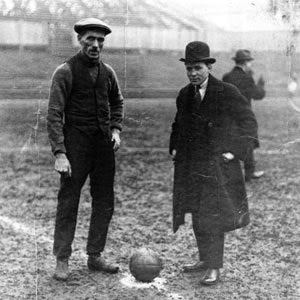
Billy Meredith

Billy Meredith looking very workmanlike. Who's the man in the bowler?
We'll be back in a week or so.

1.9.14

There's no 'I' in 'team'?

It may be apocryphal, but a lovely story anyhow. Professionalism is still 6 years off, and the England team is still dominated by the old Public Schoolboys and 'Varsity men. Combination play has yet to replace the old dribbling style. 
The place, Kennington Oval.
England v Scotland, March 3rd 1877.
The principals, Alfred Lyttelton and Billy Mosforth.


Alfred 
Lyttelton
Cambridge University, Member of Parliament, Queen's Counsel, Secretary of State for the Colonies.
An England Test cricketer and a superb field athlete and racquet sportsman.Lyttelton was a strapping 6ft 1 (1.85m) , and learned his football playing the Eton game. 


Billy Mosforth

One of the first England internationals to rely on a trade for his income, Mosforth was an engraver, and later a publican. 
A proto professional who turned out for 8 different Sheffield based clubs (Albion, The Wednesday, Zulus, Hallam, Rovers, Heeley, Lockwood Brothers and United) and was said to follow the money even in the days when professionalism was still outlawed. 
An all round sportsman, a runner and hurdler and a good club cricketer. 
There were physical differences in the classes in Victorian England, which were often in evidence when teams from the industrial north met opponents from the south- and Mosforth (5 ft 4- 1.63m) being 9 inches (22cms) shorter than Lyttleton is an example of this. 

Sheffield had taken to the combination game in the early 70s, possibly influenced by the play of the Royal Engineers. The Sheffield offside rule had also been more conducive to a passing game. Mosforth was a noted exponent of the new skill- the screw shot. He was also a very accurate crosser of the ball. 
Lyttelton  was a heads down and charge dribbler. At some point during the game , which England lost 3-1, Mosforth apparently became very annoyed at Lyttelton's selfish approach, and, unabashed by the barriers of class, let his teammate know it. We don't know what form Mosforth's admonishment took. Yorkshiremen are notoriously blunt.

Lyttelton's reply, or at least the reply he is alleged to have made, has survived.
I play, sir, for my own pleasure.