Showing posts with label Kit. Show all posts

26.9.16

In Touch with all Requirements


When ordering footballs please mention Association or Rugby...
The best ball here costs 9/3*. An agricultural labourer earned 14/ per week.


*Prices are in shillings /pence. 12 pence to a shilling, 20 shillings to a pound. 

11.8.16

John Bull


The 'Englishness' of football celebrated in the brand name of these German boots.  


12.5.16

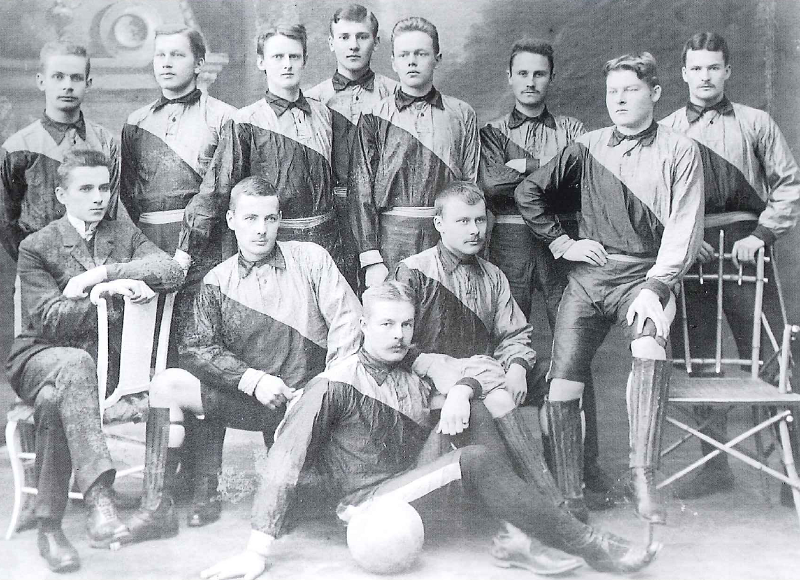
Polyteknikkojen urheiluseura (PUS)

1906

Polyteknikkojen urheiluseura  (PUS) was founded in 1903 at the Helsinki University of Technology. In 1909 they won the national championships. Finland was, at the time, a part of the Russian Empire. The club name was changed to Aalto-yliopiston urheiluseura as recently as 2010. The shin guards on display above are pretty impressive. Note also the gauntlets won by the goalkeeper (seated).

1909


9.4.16

3.4.16

F. Boyington's Football Boots Are Unequalled

Nottingham Evening Post 28.09.80

Frederick Boyington played cricket and football for a club in Nottingham called Castle Gate. He relocated to London in the mid 1880s, and although the 1891 census records his occupation as Cricket and Football Guard Maker he was, for 40 years, the scorer for Surrey County Cricket Club.
S.W Widdowson's contribution to the history of the game has already been covered here.

1.8.15

Clash of Colours, 1882

When we think of the professional football clubs of the industrialized north that came to dominate the game in the 1880s, it is easy to consider them as being an entirely different entity from the southern clubs of the amateur gentlemen. There was, however, a thread that linked many of the clubs of Lancashire to the public schools from which Association football had developed in the 1860s.
Turton, probably the first Lancashire side, were founded by Old Harrovians (of which more later). The case we will look at here is that of the team that really put the cat among the pigeons by reaching the FA Cup Final in 1882, Blackburn Rovers.


1878:Notice in the picture above how there is inconsistency in the jerseys.

The 'quartered ' shirts and the Maltese Cross motif that Rovers wore in the early days pointed to their (surprising) public school origins. Founder  Arthur Constantine was an Old Salopian (Shewsbury). 


Shrewsbury School, 1912

According to Charles Francis in The History of Blackburn Rovers (1925) several of the 17 present at the  St Leger Hotel On 5th November 1875 were young fellows who had just finished their education at public schools
The stipulation in setting out the club livery was that a Maltese cross be worn on the left breast This motif was worn by both the Shrewsbury and Malvern school teams.


Malvern College

Malvern College  provided Rovers with players such as the Greenwood brothers (Thomas, Harry and Doctor) and Fred Hargreaves.


Blackburn Rovers' strip remains one of the most readily recognisable in the world of football, and was much imitated. However, when their first chance of glory came as they reached the FA Cup Final in 1882 they were denied the opportunity of wearing their famous strip.The 11th FA Cup Final was the first to necessitate a change of colours.
John Lewis recalls a letter from Alcock- there is no evidence that a coin was tossed or any lots were drawn in order to decide who changed kit- Rovers were instructed, by letter. Lewis was convinced that this was a bad omen. Rovers also requested assistance with their travelling expenses; the FA declined.

On the day Rovers wore narrow black and white  hoops in the mode of Queen's Park. Old Etonians wore harlequin shirts of light blue and white (a departure from their previous plain light blue). 


26.7.15

Artistic License


This large ceramic tile was produced by the Spode company in the 1870s. There is some lovely detail in evidence, such as the construction of the ball and the costumes of the players. However, a closer look at the jerseys reveals some artistic license. Is it fair to assume that the rose and the thistle motifs are meant to suggest that what we are seeing here is an England v Scotland clash, played out against a backdrop of rolling hills?
England, of course, have never sported the rose as a national football emblem (it has always been the crest of the Rugby Union team). The thistle is usually Scotland's Rugby emblem, but the Association team adopted it in the 1890s before a return to the lion rampant that had featured from the first ever international. The combination of hooped jerseys (navy and white) and the thistle emblem might have appeared in 1881, but those jerseys were collared.
See also: http://gottfriedfuchs.blogspot.co.uk/2014/05/egg-chasers.html


19.1.15

A humiliation that staggered the football world: Swansea Town v Blackburn Rovers- 1915


On Saturday Swansea City travel to Blackburn Rovers in the 4th round of The FA Cup.
When the 2 met in January 1915 for a first round FA Cup tie, the outcome was one of the biggest upsets in the history of British football. 
Blackburn Rovers were a big, big club. Established 40 years previously they were founding members of The Football League. The previous season Rovers had won the Championship (their 2nd title).  They had won the FA Cup 5 times. At the time of this match (09.01.15) they were 5th in Division 1.
Their line up featured 4 England internationals ( Crompton, Bradshaw, Latheron and Hodkinson) and 1 Scottish international ( Aitkenhead).
Crompton had played for England a remarkable 41 times ( a record which stood for 38 years), captaining on 21 occasions. 
Rovers offered Swansea a large sum to switch the match to Ewood Park but the offer was declined and 16,000 people were at the Vetch to see the League champions. 
Swansea Town were in the second division of the Southern League. They had only come into existence in 1912. Their line up that day was light on stars. Club captain Thomas Hewitt had played for Wales 8 times (1911-14). Captain for cup matches that season was Joe Bulcock The man who became a hero that day was a 16 year old Rugby player. Benny Benyon was only playing 'soccer' because Rugby was suspended during the war. 
Blackburn attacked relentlessly from the outset, but in the 20th minute Swansea broke out of defence in a move, started and finished by Beynon, that covered the length of the pitch and gave the Swans an unlikely lead. 
At half time Swansea were reduced to 10 men when Lock was injured. 
Rovers bombarded the Swans goal in the 2nd half. They were awarded a penalty but remarkably Billy Bradshaw, who had scored with 36 consecutive spot kicks, shot wide. Harry Read went off injured and Swansea had to hold out for the last quarter of an hour with just 9 men. 
It was, according to  contemporary newspaper reports: A humiliation that staggered the football world.
As the photograph shows, Swansea Town were unique in having a strip in which jersey and knickers were of the same colour.
Benny Beynon returned to Rugby after the war and played for Wales, but in a ruling that highlights the stupidity of the way in which that game was administered, he was banned for professionalism on account of his Association football exploits. He went to Oldham as a Northern Union player.
Joe Bulcock (Town) and Eddie Latheron (Rovers) were both killed in the war.

Swansea Town

Blackburn Rovers
Hurst
GK
Alf Robinson
Tom Hewitt
RB
Bob Crompton
Joe Bulcock
LB
Tommy Suttie
John Duffy
RH
Bert Walmsley
Lock
CH
Percy Smith
Anderson
LH
Billy Bradshaw
Harry Read
OR
Alex McGhie
Brown
IR
Wattie Aitkenhead
Benny Beynon
CF
Johnny Orr
Gilboy
IL
Eddie Latherton
Amos Lloyd
OL
Joe Hodkinson


12.12.14

Ireland 1914

Ireland, the last of the 4 'Home Nations' to enter the International arena, had been the perennial whipping boys of the British Home Championship in the early days,
 In 1903 they shared first place with Scotland and England (all 3 finished the campaign with 2 wins and a defeat) and in 1913 enjoyed their first victory over England.


They won their first British Home Championship in 1914.


                                                                            v Wales

19.01.14
Wales  1 Ireland 2
Racecourse, Wrexham
GK
Fred McKee
Belfast Celtic


RB
Bill McConnell
Bohemians


LB
Sandy  Craig (c)
Greenock Morton


RH
Val Harris
Everton
Off injured at 45

CH
Pat O'Connell
Hull City


LH
Dave Rollo
Linfield


OR
Ted Seymour
Bohemians


IR
Sam Young
Linfield


CF
Billy Gillespie
Sheffield United
25, 65

IL
Billy Lacey
Liverpool


OL
Louis Bookman
Bradford City


Coach: R Bennett


14.02.14
England 0 Ireland 3
Ayresome Park, Middlesbrough
GK
Fred McKee
Belfast Celtic

RB
Bill McConnell
Bohemians

LB
Sandy  Craig
Greenock Morton

RH
Harry Hampton
Bradford City

CH
Pat O'Connell (c)
Hull City

LH
Mickey Hamill
Manchester United

OR
Dave Rollo
Linfield

IR
Sam Young
Linfield

CF
Billy Gillespie
Sheffield United
36
IL
Billy Lacey
Liverpool
6, 80
OL
Frank Thompson
Clyde

Coach: Rab Torrans


14.03.14
Ireland 1 Scotland 1
Windsor Park, Belfast
GK
Fred McKee
Belfast Celtic

RB
Bill McConnell
Bohemians

LB
Sandy  Craig
Greenock Morton

RH
Val Harris
Everton

CH
Pat O'Connell
Hull City

LH
Mickey Hamill (c)
Manchester United

OR
Johnny Houston
Everton

IR
Rab Nixon
Linfield

CF
Sam Young
Linfield
89
IL
Billy Lacey
Liverpool

OL
Frank Thompson
Clyde

Coach: Hugh McAteer

Ireland wore their St Patrick's Blue strip in all 3 matches:


The line ups , which include players based in England, Scotland, Northern Ireland and Dublin, show that the Ireland side in this era was representative of the whole of Ireland. Of the 16 players selected, 7 were from what is now Northern Ireland and 9 (including Bookman, who was born in Lithuania but grew up in Dublin) from what is now The Republic of Ireland. 

v Scotland. The name of the cat being held by Mickey Hamill is unknown to me. He did his job though, Sam Young's late equalizer meant that Ireland were champions. 


5.5.14

German advert c 1890


The Latest Novelty! announces this advertisment for a Berlin sports shop.
Football boots for a striker weighing just 600 grammes- modern football boots (or shoes) weigh in at about 250 grammes.
As football spread throughout the World there was no doubt that the best kit was produced in Britain. Continental retailers would boast that the gear on sale was imported from the UK.
The Victor ball was played with for 24 matches by Bolton Wanderers. The inference is that it kept its shape and didn't rupture or burst, something that the old style balls were prone to.


20.4.14

Patent Footballs


Richard Daft was a cricketer. His son, Harry Daft, played football for Notts County and was an FA Cup winner (1894). He was capped 5 times by England. He also enjoyed a good county cricket career. 
The heaviness of rain affected leather balls was a factor that not only affected the spectacle of the game but also the health and safety of the players. Interesting to see that measures to combat this problem were being taken as early as the 1870s. 


28.3.14

Sam Weller Widdowson


In 1874 the Nottingham Forest skipper Sam Weller Widdowson decided to protect his shins with modified cricket pads, cut down to size. 
 Widdowson made 1 appearance for England in 1880, by which time he had already been chairman of Forest for a year. 


Initially the shin guards were seen as a novelty, and were even a source of derision. They were also something of a luxury (only one player in the unnamed Scottish team above seems to be wearing them). Partick Thistle, on the other hand are far better protected...