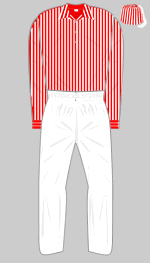
Showing posts with label Forest FC. Show all posts

7.10.15

Forest v Barnes 1863


Bell's Life in London and Sporting Chronicle- 19.12.63
The Forest Club was founded by CW and JF Alcock.  JF Alcock was a delegate at the 6  Football Association meetings held in October-December 1863 and was elected onto the first FA Committee in 1864. 
The cutting contains an early reference to the Football Association's ideal of seeing their new rules adopted universally.

11.2.15

“Wanderers” Football Club Season 1865-1866

Forest FC of Leytonstone, formed in 1859 and adherents of the Harrow Rules, relocated to London in 1864 and adopted the name Wanderers (although their 'home' ground was Battersea Park).
Copied this from The Code War: English Football Under the Historical Spotlight  by Graham Williams. Not sure of the original source...


“WANDERERS” FOOTBALL CLUB
SEASON 1865-1866
LIST OF MEMBERS.
                      Alcock, J.F                Green, F           Pember, A
                      Alcock, C.W              Green, J.F         Phipps, H.G
                      Allfrey, W.M              Gaillemaid, A.G   Prior, J.T
                      Baker, A                   Hall, C.H            Reid, C.F
                      Baker, W.F                Harper, Syd.       Richardson, H
                      Bowen, E.E                Head, H            Sparks, T.H
                      Butler, C.F                 Howlett, W.O       Smyly, W.C
                      Burnett, E.W              Jackson, C.D       Tayloe, J.E
                      Crompton, A               Lucas, F            Tebbut, A.M
                      Cruikshank, J.A           Lucas, J             Tebbut, C.M
                      Cutbill, W.J.C              Ludlam, J.W       Thompson, A
                      Elliot, J                      MacKenzie, A.W  Thompson, W
                      Gillespie, E.W             Martin, J.B          Thornton, P.M
                      Green, A                    Morley, J.L          Tupper,C.H
                                                            Weber, C.L

LIST OF MATCHES
ALREADY ARRANGED
1865
Saturday, 28th October, Civil Service, at Battersea Park
Wednesday, 8th November, Charterhouse School, at Charterhouse
Saturday , 11th      ”      Crystal Palace Club, at Penge
  ”       18th      ”      Westminster School, at Westminster
  ”       25th      ”      Forest School, at Walthamstow
  ”     2nd   December,  “N.N.s” at Kilburn
  ”     9th        ”       Harrow School, at Harrow
  ”    16th       ”       Reigate Club, at Reigate

1866
Saturday, 6th January, Crystal Palace Club, at Penge
    ”    13th   ”    Civil Service, at Battersea Park
    ”     20th   ”     “N.N.s” at Kilburn
    ”    24th February, Civil Service, at Battersea Park

All Communications respecting Matches &c, to be addressed to C.W ALCOCK, 155, Fenchurch Street

Uniform Flannel can be obtained of Gann, Jones & Co, 171, Fenchurch Street


11.8.13

C.W. Alcock


The most influential figure in the evolution of Association Football,  Charlie Alcock was at the center of many of the key developments in the game.
Alcock attended Harrow School where he played football. At the age of 17 he and his brother J.F. Alcock founded Forest FC , the club which in 1863 evolved into the Wanderers, the dominant club of the first 2 decades of the Association game. 

Organizer.
1870 -Football as an 11 a side game: More than eleven we do not care to play as it is with greater numbers it is our opinion the game becomes less scientific and more a trial of charging and brute force...
20 July 1871- it is desirable that a Challenge Cup should be established in connection with the Association for which all clubs belonging to the Association should be invited to compete.
Alcock's proposal led to the inauguration of the FA Cup.
Football as a passing game: Nothing succeeds better than what I may call a 'combination game'.
1870- Alcock organized a series of representative matches between England and Scotland in 1870. It was Alcock's response to criticism that these games were not truly representative internationals that led to the initiation of the official internationals:
I must join issue with your correspondent in some instances. First, I assert that of whatever the Scotch eleven may have been composed the right to play was open to every Scotchman [Alcock's italics] whether his lines were cast North or South of the Tweed and that if in the face of the invitations publicly given through the columns of leading journals of Scotland the representative eleven consisted chiefly of Anglo-Scotians ... the fault lies on the heads of the players of the north, not on the management who sought the services of all alike impartially. To call the team London Scotchmen contributes nothing. The match was, as announced, to all intents and purposes between England and Scotland.
The Scotsman 28,11,70

Player.

1859-63- Forest
1863-76 - Wanderers (FA Cup winner 1872).
Also represented Old Harrovians, Harrow Chequers and Harrow Pilgrims.
1864- Secretary's XI versus President's XI  (the first official game under the Association rules).
1866- Football Association vs Sheffield. 
1870-72 - played in 5 unofficial matches for England v Scotland.
1875- Capped by England and scored in his only international , in which he was also captain.  

Aministrator.

1866  FA committee.
1870-95  FA Secretary.
 President of the Surrey FA.
Vice-president of the London FA.
Alcock objected to the argument ‘that it is immoral to work for a living’—even if that work took the form of sport. He twice proposed the legalizing of professionalism under strict controls before it was accepted in 1885, and was,  uniquely among his peers, positive in his attitude towards the foundation of the Football League. 

Official.

Umpire in first international match, 1872. 
FA Cup Final referee 1875 and 1879.
1893-first president of the Referees Association.

Writer.

The Football Annual- 1868 onwards.
Football: our winter game -1874.

Football. The Association Game -1902.

The Book of Football: a Complete History and Record of the Association and Rugby Games- 1906.

13.8.12

Forest FC 1863


Forest FC predated Association Football. Formed in 1859 by a group of former public schoolboys under the direction of CW Alcock, they played in a variety of codes.
They played near Epping Forest, hence the name. In 1863 the Forest Club was among the founder members of The Football Association (the FA) and adopted the rules set down by that body, although they continued to play occasional matches under other sets of rules against clubs not affiliated to the FA.
The club changed its name to Wanderers in 1864.
The picture above is the earliest Association team photograph that I have come across.

6.8.12

The Founder Members of The Football Association 1863

Barnes (London) participated in the first ever match under FA rules, a 0-0 draw against Richmond (who were not FA members). They also competed in the first ever FA Cup and continued to do so through to the 1885–86 competition. Switched to Rugby Football.


Blackheath FC (London) founded in 1858, is the oldest open rugby club in the world. Withdrew from the FA in protest at the proscription of 'hacking', concentrating on Rugby Football.
Blackheath Proprietary School (London) were also in on the foundation of the FA.


Civil Service F.C.  (London)  another club who played both Association and Rugby Football- when the rift over the rules led to other clubs focusing on Rugby, Civil Service continued in both codes. Literally ambassadors of the game, playing fixtures overseas.


Crusaders F.C.  (London) the club continued to play in the FA Cup into the 1880's, but I cannot find any more information about them.


Surbiton (London) - of which I know nothing.
Crystal Palace F.C (London) - not the Crystal Palace who still grace the Football League. This club was formed by groundskeepers at the Great Exhibition site at Hyde Park and lasted from 1861-1876.


Leytonstone Forest (Leytonstone, Essex) - also known as Forest FC,  the ex public schools club that evolved into The Wanderers. 


N.N. Club or N.N. Kilburn (London) -  The No- Names provided the FA with its first president, Arthur Pember.
 Kensington School (London) -  a school that favoured 'dribbling' types of football (like Eton and Charterhouse) over the carrying game (Rugby)
Perceval House (London) a school from Blackheath who also favoured the 'hacking and handling' route. After leaving the FA in December 1863 they vanish from history.