12.11.12

James Prinsep


This lusty looking young man, pictured in the Boy's Own Paper's Famous English Football Players (1881), is James Frederick McLeod Prinsep. In 1881 he was in the Old Carthusians side that won the FA Cup.
Two years earlier Prinsep had enjoyed a remarkable week that saw him achieve two records that both went unbeaten for more than 120 years.
On March 29th 1879 Prinsep was in the Clapham Rovers side that lost to Old Etonians in the FA Cup final at The Oval. Prinsep's age was 17 years and 245 days, making him the youngest Cup finalist until 2004.
One week later on April 5th he was back at The Oval making his solitary appearance for England in a 5-4 win over Scotland at the age of 17 years and 252 days
This record, as England's youngest international, stood until 2003.
At the time of these achievements Prinsep, who was born in India, was at  the Royal Military College, Sandhurst.
He had a distinguished career in North Africa but died at the age of 34 having caught pneumonia playing golf in Scotland. 

Uruguayan playing Cards c 1930

These rather worn and battered portraits of Uruguayan footballers appear on the backs of playing cards. Judging by the players featured I think they come from the early 1930s. 


Juan Carlos Alzugaray  (Rampla Juniors)-won 2 caps at the 1924 Copa América.


Peregrino Anselmo (Peñarol) - played 180 league games for Peñarol in a 13 year career, scoring 102 goals in the process. A World Cup winner in 1930, at which he scored 3 goals, and a 1928 Olympic Gold medal winner.

Fausto Batignani  (Liverpool (Montevideo)) - a goalkeeper who was capped 11 times and a 1928 Olympic Gold medal winner.

Braulio Castro  (Peñarol) - a prolific goalscorer at club level he didn't score in his 10 international appearances between 1932-37. 
 

Enrique Fernández  (Nacional)- when Uruguayan football was still amateur he went to play for  Independiente in Argentina. He returned to Nacional when professionalism was introduced  Fernández won the Uruguayan Championship with 
Nacional in 1933 and 1934 . He played played 111 games and scored 51 goals for Nacional. In 1935 he moved to Barcelona , but returned to Uruguay on the outbreak of the Spanish Civil War. His career was ended by injury at the age of 24.
8 caps , 1 goal. 


Lorenzo Fernández (Peñarol) - 1928 Olympic Gold medal winner, World Cup winner in 1930,Copa América winner 193531 appearances, 4 goals.

Álvaro  Gestido (Peñarol- played 25 matches for the  national  team1928 Olympic Gold medal and 1930 World Cup winner.

Luis Mata (Peñarol) -  8 caps with 1 goal spread over 12 yrs.


Juan Pedro Young  (Peñarol) - known as Tiger or
Cañonero- top scorer in the 1933 domestic  season - capped once by Uruguay. 

 José Alberto Taboada (Wanderers Montevideo) - 6 caps and 1 goal, Copa América winner,  1935.


11.11.12

1914- 1918

English soldiers play a game of football close to enemy lines...

R&R

A Boy's Own romanticized version of going over the top.

The Footballers' Battalions 1914-18


There's an article on the formation of the Footballers' Battalions here: http://www.soccer-history.co.uk/footballersbattalion.pdf

10.11.12

English teams in early international club competitions


Clapton FC were the first British club to play on the continent. In 1890 they traveled to Antwerp and beat a Belgian XI 8-1.

Following this groundbreaking  trip it became increasingly common for British clubs to play abroad. Usually these fixtures were part of friendly summer tours that had a missionary purpose. Continental teams were keen for the prestige of playing against British clubs and viewed the experience of getting thrashed by some amateurs on a jolly as a valuable learning experience.
When the mania for football on the continent reached the point where the idea of international club competitions was being explored, major British teams were absent, and the results of friendly fixtures at the time reveals the gulf that existed between British and continental football (just a few examples: 1894: Standard Athletic Paris 1, Belsice 8; 1900: Racing Club Paris 1, Barnes 3; 1901: Germany XI 2, Aston Villa 6; S Brugeois 0, Cambridge University 4; 1904: Select Paris 2, Newcastle United 11; Union Saint Gilloise 1, Tottenham Hotspur 8; Karlsruher FV 0, Newcastle United 7). 
1909 was the watershed year, with two English amateur sides competing in tournaments on the continent.

The Challenge International du Nord had first been contested by French and Belgian clubs in 1898 with Dutch and Swiss teams joining in 1905.

When, in 1909, England sent a representative to this tournament it wasn't league champions Newcastle United or FA Cup winners Manchester United who went, but rather Eastbourne FC of the Southern Amateur Football League.
Entering at the semi final stage they beat Le Havre Sports (2-0) and Racing Club Roubaix (5-1) to win the trophy.


Reigate Priory


 Reigate Priory (also of Southern Amateur Football League, and relegated from the Senior A section that season) repeated the success in 1910, with Cambridge Town (another Southern Amateur Football League outfit in only their third season) losing the 1911 final, winning the trophy in 1912 reaching the semi finals in 1913.

In 1909 Sir Thomas Lipton (who had donated a trophy to be played for between Argentina and Uruguay from 1905) sponsored an international club tournament, held in Turin. The FA didn't want anything to do with it, so Sir Thomas invited West Auckland of the Northern league to represent England.


West Auckland

Other teams in the 1909 tournament were Torino XI (Italy, a combined Torino / Juventus team), Stuttgarter Sportfreunde (Germany) and FC Winterthur (Switzerland). West Auckland beat Stuttgarter and Winterthur, both by 2-0, to lift the trophy.
in 1911 West Aukland were invited to defend the trophy. In Turin were joined by Juventus and Torino (Italy) and FC Zurich (Switzerland). West Aukland successfully defended the title, retaining the trophy in perpetuity. Having seen off FC Zurich in the first round they beat Juventus 6-1 in the final.

李惠堂


Lee Wai Tong was a forward with South China AA, the de facto China national team that won the 192519271930, and 1934 Far Eastern Games, and in 1936, he captained of the China squad that competed at the Berlin Olympics . This team was made up of ethnic Chinese players from Hong Kong, Shanghai, Singapore, and Java.


In a 24 year career, mostly with South China AA, Lee reputedly scored 1260 goals.

Forget racial stereotypes. He was 1.80 m tall, taller than Dixie Dean, Matthias Sindelar, Giuseppe Meazza or Hector Scarone.

9.11.12

The Team of the Macs

 The Team of the Macs

Liverpool F.C. was formed following a rift in the board of Everton (which will be covered in more depth in a later post) and originally their name was going to be Everton F.C. and Athletic Grounds, Ltd.
Liverpool joined the Lancashire league for the 1892-93 season.
"Honest John"McKenna, an Ulsterman and friend of President John Houlding from the Orange Order, scoured Scotland for bargain signings, and consequently the Liverpool first team that season contained no English players. It was known as The Team of the Macs.


Their first game was a friendly against Rotherham Town on 1.9.1892. Liverpool won 7-1.

8.11.12

Goalkeepers' Attire

Foulke- Bradford City

Doig- Sunderland*

Looking at pictures of 19th and early 20th century football matches one thing that is noticeable is that the goalkeepers wore the same colours as the outfield players. This must have led to considerable confusion during goalmouth scrambles.
It was decided at the annual meeting of the Football League in June 1909, that the goalkeeper must play in distinctive colours (they prescribed scarlet, royal blue, or white) in order to assist the referee. Royal (?) green was added in 1912. From June 1921 all goalkeepers in international matches were to wear jerseys of deep yellow.

Goalkeepers today might suffer the trials of wearing particularly lurid kit. In days gone by, with the selection of knitwear and headgear at their disposal, goalkeepers could emphasize their alleged eccentricity via their onfield attire.
Here are some great custodians who also happened to cut a spectacular dash:


 Ricardo Zamora (Spain)

Rudolf Hiden (Austria)

Leigh Richmond Roose (Wales)

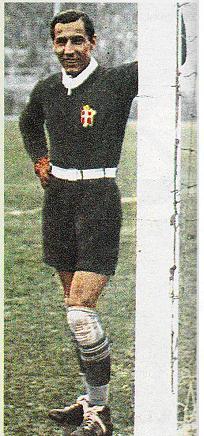
Gianpierro Combi (Italy)

Elisha Scott (Ireland)

 Harry Linacre (Nottingham Forest)


Américo Tesoriere (Argentina)

* Many sources assert that wearing of gloves was pioneered in the 1950's and only became common in the 1970s. However, early images show goalkeepers from many lands wearing a selection of gloves, and surely not only for keeping their 
hands warm.

Hugo Meisl and Jimmy Hogan- The Danubian School


Under Meisl soccer became almost an exhibition, a sort of competitive ballet, in which scoring goals was no more than the excuse for the weaving of a hundred intricate patterns.
Brian Glanville.

Hugo Meisl was the most influential figure in European football during the first half of the 20th century. As a player he had represented Cricketer and also served as a referee. he was head of the Austrian Football Federation from 1912 to 1937, and managed the national team in two periods, in 1912-14   and from 1919 -1937.As manager of Austria the cosmopolitan Meisl envisioned a fluid and beautiful way of playing football, based on the principles of movement.
The style of play was described by Willy Meisl, Hugo's brother, as The Whirl. This involved a perpetual interchanging and fluidity between all 10 outfield players, in which there would be no such thing as a purely defensive or a purely attacking player. 
 with assistance of an English coach, Jimmy Hogan.


In 1912, Austria drew 1-1 against Hungary. The game was refereed by Englishman James Howcroft. Ever keen to develop, Meisl asked Mr Howcroft for some advice on how to improve his team. Mr Howcroft's opinion was that they needed a professional coach to work with them on basic technique. As it happened Mr Howcroft knew just the man they needed. He recommended Jimmy Hogan, the former Bolton Wanderers player who had been coaching in the Netherlands.
Meisl promptly appointed Hogan to work with leading Austrian clubs, but mainly to prepare the Austria national squad for the Stockholm Olympics.


There is a strong case for arguing that Hogan, a journeyman professional who had also played for Rochdale, Burnley, Nelson , Fulham , Swindon Town during an 11 year career was to become one of  the most influential coaches in the history of football. The origins of the great Hungarian post war style, Netherlands Total Football and even the development of tactical awareness in Brazilian football (via Dori Kruschner*) can be traced back to the work that Hogan did in Central Europe.  

Hogan helped Meisl to put his vision into action. Hogan promoted  a style that emphasized  greater ball-control, attacking freedom, creativity, quick passing, and better physical preparation  Football was to be played on the ground, not in the air, and it was a game for brains as well as muscles.  
Essentially the 2-3-5 pyramid remained untouched (in fact Willy Meisl remained an advocate of thew pyramid formation until well into the 1950s). The forward line was complemented by wide half-backs and an attacking centre-half.


We played football as Jimmy Hogan taught us. When our football history is told, his name should be written in gold letters 

Gusztáv Sebes- coach of the 1950s Hungarian Golden Team.


*Izidor "Dori" Kürschner was known as Dori Kruschner in Brazil

7.11.12

The Baltic Cup 1928

To simplify a complex episode in history -The Baltic countries of Lithuania, Latvia and Estonia gained their independence from Russia and Germany at the conclusion of the 1914-18 war.
Within a few years they had entered the arena of international football.
Estonia debuted with a 6-0 away defeat at the hands of Finland in October 1920. 
Latvia played their first international against Estonia in September 1922. The match in Riga was a 1-1 draw. 
Lithuania's entry onto the international scene came in June 1923, when Estonia beat them 5-0 in Kaunas.

All three Baltic states competed in the 1924 Olympics.
Estonia  lost 1-0 to USA in the preliminary round, which also saw Lithuania beaten 9-0 by Switzerland.
Latvia received a bye into the first round, where they were  beaten 7-0 by hosts France.
Over the next few years the three nations played each other in friendlies.
 In 1928 the Baltic Cup was held for the first time, a round robin tournament held at Tallinn on 25th, 26th and 27th July, which was won by Latvia.

25.7.28  Latvia      3-0   Lithuania
26.7.28  Lithuania  0-6   Estonia
27.7.28  Latvia      1-0   Estonia


Arkādijs Pavlovs (Latvia), scorer of the first ever Baltic Cup goal.

Arnold Pihlak (Estonia), the Austria Wien player scored 3 against Lithuania.

6.11.12

Hussein Hegazi


Cairo born Hussein Hegazi came to London as a 19 year old in the summer of 1911 to study Engineering at the University College London. 
He played for Dulwich Hamlet and was soon picked up by Division 2 side Fulham. Hegazi scored  for Fulham against Stockport County on 11.11.11 in what turned out to be his sole appearance for the Craven Cottage club. He felt a sense of loyalty to Dulwich Hamlet, but his situation had also fired a debate on the 'poaching' of players by professional clubs.
Hegazi represented the London FA on 5 occasions.
Hegazi was particularly busy during the spring of 1912 -  in March University College London traveled to Prague, where they were beaten 6-0 and 5-1 by Slavia Prague in successive days . UCL must have grown tired of the sight of Slavia players, as 7 of them also turned out for Bohemian Universities in a game that was drawn 2-2 . 
On the return journey Hegazi scored a hat trick as Olympique Lillois were beaten 3-0.  
In April 1912 he toured Netherlands, playing for Hamlet against Sparta Rotterdam and Hercules Utrecht.
Having won his Cambridge Blue in a 2-1 victory over Oxford, Hegazi returned to Egypt in 1914, initially joining Sekka before moving to Al Ahly. After 8 seasons at Al Ahly he transferred to Zamalek. 
He played for Egypt in the 1920, 1924 and 1928 Olympics as Africa entered the arena of International football.


I am indebted to the work of  Dr Tarek Said and Mr. Jack McInroy.