Showing posts with label Henry Renny-Tailyour. Show all posts

7.3.15

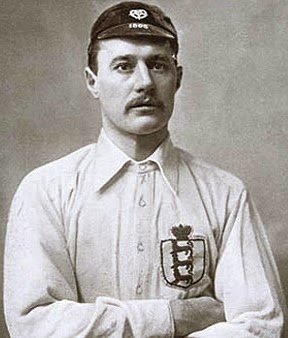
Henry Renny-Tailyour


Born in India, raised in Montrose, educated at Cheltenham College and Royal Woolwich Military Academy. Henry Waugh Renny-Tailyour was a great all round sportsman.
In May 1870 in the games between the 2 Royal Military Academies, Woolwich and  Sandhurst , he won the 1/2 mile  race ( in 2 mins 10), and finished  2nd in the mile.  The following month Renny-Tailyour scored a century in the cricket match between the Royal Military Academy  and the Royal Engineers. In July 1870 he graduated from the Academy and became a Lieutenant in the Royal Engineers.
In 1871 Renny-Tailyour represented Scotland in the  4th match in the unofficial 'England v Scotland' series, played at The Oval on 18th November. Renny -Tailyour scored  in a 2-1 defeat. 
Further evidence of the Lieutenant's versatility came when on 5th February 1872 at The Oval when he played (as a forward) in the second ever  international under Rugby Football rules. A dead leg received in this match kept Renny-Tailyour out of action for the next couple of weeks, meaning he was unable to play in the 5th 'Alcock International'.
On 16th March that year however he was back at The Oval, playing in the first FA Cup Final, in which the Royal Engineers went down 1-0 to The Wanderers. 
In 1873 Renny-Tailyour became the only man to represent Scotland at both Rugby and Association when he was one of 4 English based players called into service for the 2nd international. The Oval was again the venue, and in the 10th minute, with England 2-0 ahead, Renny-Tailyour scored Scotland's first ever goal in international football. (England won 4-2).

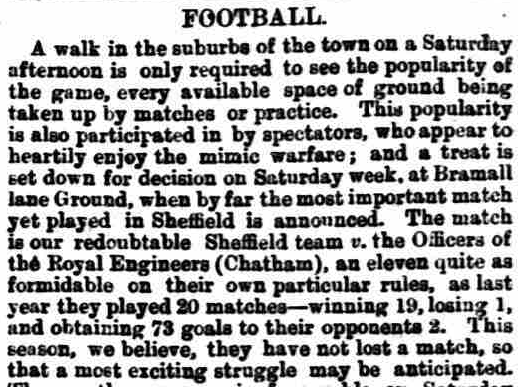
Renny-Tailyour features prominently in match reports of the Royal Engineers' club matches during the early 1870s, a period during which they were a major force in terms of both results and the evolution of style. In 1871-72 they lost just 1 out of 20 games (the FA Cup Final) scoring 73 to 2. In the 4 seasons 1871-72 to 1874-75 the stats were:


P
W
D
L
F
A
86
74
9
3
244
21

Another of those very rare defeats came in the 1874 FA Cup Final, a 2-0 loss against Oxford University.
  Renny-Tailyour won the FA Cup with Royal Engineers at the third attempt in 1875. In a replayed final The Sappers beat Old Etonians 3-0, (after a 1-1 draw), with Renny-Tailyour scoring in both matches.


This seems to have marked the end of Renny-Tailyour's football career. He married in the summer of 1875 (his wife was the sister of  Royal Engineers teammate and England internationalist Cecil Wingfield-Stratford).

During the 1875-76 season he was being written about in the  past tense in football reports ruing the decline in the Royal Engineers team (and partly attributing this decline to the 'loss' of Renny-Tailyour).
In March 1876 he was appointed Aide De Camp to the Lord Lieutenant of Ireland.
One aspect of Renny-Tailyour's sporting life persisted into the 1880s. His first class cricket career extended from 1873 to 1883. He represented MCC and Kent as well as playing in the Gentlemen v Players matches. In 1880 he scored 266 for Royal Engineers against The Civil Service, an uncommonly high score at the time.  


21.5.14

Egg Chasers

This illustration appears in many soccer history books, but  the roses on the jerseys tell us it is in fact a Rugby match- England vs Scotland at the Oval, 1872. 


In the early days, of course, an interest and proficiency in more than one code was unsurprising.  The rules of engagement were often a mishmash and would change from week to week according to the opposition and the mutual agreement of the captains. This, of course, was the very situation that the Football Association set out to counter. 

The very first encounter played under the 1863 rules was between two clubs, Barnes and Richmond, who later decided to follow the Rugby Union route. 
Several of the northern clubs converted (no pun intended) from Rugby to Association (notably Preston North End, Burnley and Manningham). Clapham Rovers alternated- Association one week, Rugby the next.

Some individuals excelled in both codes. Here are just a few examples:

Robert Barker kept goal for England during much of the first ever international match. In the absence of the preferred goalkeeper he was chosen due to his Rugby experience.

Henry Renny-Tailyour of the Royal Engineers represented Scotland (as a forward) in the second ever international Rugby Union match at the Oval in 1872. In fact it is on record that he was unavailable for subsequent Association matches due to an injury sustained in this match. In 1873 he played in the second international football match for Scotland, against England, again at the Oval, getting onto the score sheet. Scotland lost both these matches.  Renny-Tailyour won the FA Cup with Royal Engineers at the third attempt in 1875.

Reg Birkett was the scorer of the first try in international Rugby- for England vs Scotland in 1871. A dual-coder with Clapham Rovers, Birkett was on the original RFU committee and played for England 4 times.
Birkett was also an FA Cup winner with Rovers in 1880, his second Cup-Final appearance.
He kept goal for England in their 1879 5-4 win over Scotland at the Oval.

Dr. John Smith- as an Association player Dr Smith played in both the English and Scottish FA Cup finals. He was the first man to score 3 goals in  a Scottish Cup Final. He represented his country 10 times (1877-84), scoring 10 goals. His clubs were  Mauchline, Edinburgh University and Queen's Park. His football career was ended by the stringent anti professionalism laws of the Scottish FA (the Dr played as an amateur for Corinthians in a match against a team that included a professional, enough to get him banned!)
Playing Rugby for Edinburgh University, in 1888 Dr Smith was selected for the British Isles antipodean tour.


John Willie Sutcliffe - Rugby in the north of England was blighted by witch hunts against professionalism. In 1889  Sutcliffe represented England against New Zealand Natives, but later that year, his club, Heckmondwike, were thrown out of the RFU for professionalism.
Remarkably, Sutcliffe was then able to join Bolton Wanderers. His original role in Association had been as a forward, but he switched to goalkeeper and went on to make over 300 League appearances for Bolton before joining firstly Millwall Athletic and then Manchester United. In 1905 Sutcliffe joined Plymouth Argyle, for whom he made a further 200 plus League appearances. He ended his playing
 days at Southend, having been 24 years in professional soccer. He later went to the Netherlands and managed Vitesse Arnhem.
Sutcliffe was capped 5 times by England (1893–1903) as a goalkeeper.


Dai Davies was a half back with Llanelli. He joined Northern Union side Swinton in 1899. In the summer of 1902 Davies, who had only ever seen one soccer match and never played the game before, joined Bolton Wanderers as a goalkeeper (maybe Wanderers were inspired by the precedent of  Sutcliffe). He was a notoriously courageous 'keeper. He played in the 1904 FA Cup Final (completing an unique double, having played in the 1900 Northern Union Challenge Cup Final).
Davies spent 8 years at Bolton and was capped 3 times by Wales. He returned to Northern Union in 1910. 


22.2.14

Officers of The Royal Engineers (Chatham) on Tour


In December 1873 the Royal Engineers went on tour to Sheffield and the Midlands. The Engineers team were all serving officers and the tour was arranged around periods of leave.
The three games played are often credited with introducing the Combination Game to a wider audience.
Although the exact origins of a systematic approach to playing association football in concert with one's team mates is very difficult to pin down, but documentary evidence supports the deployment of such tactics by the Engineers from the late 1860s, predating the culture shock of the 1872 England Scotland international in which the 11 Queen's Park players used tactics that were supposedly completely alien to the English. 


Sheffield and Rotherham Independent 09.12.73


The Sheffield Daily Telegraph 22.12.73

The Engineers were an adaptable lot- they were not averse to playing Sheffield rules (they went as far as playing Rugby rules on occasions). Note the reference to the throw in and the Sheffield reporters preference for the kick in. I remember a similar debate re surfacing in the 1980s!
The Sheffield FA team who played against Glasgow in the 1870s were in turn praised and damned for using a combination game unusual among English sides. 
The Mr Owen referred to is Rev. John Robert Blayney Owen. He later played for England. Owen was at Trent College and would have turned out for Derbyshire had it not been for the injury he sustained in the match at Sheffield. 
H.W Renny-Tailyour was injured for the Sheffield game, which he umpired. He returned for the Derbyshire game. 

The Derbyshire Times 24.12.73

A capital luncheon- before the match, and a splendid banquet afterwards.  It is implied that a different set of rules was employed in each half of the Derby game. 

The Standard 26.12.73
Nottingham Forest had been in existence since 1865. Their splendidly Dickensian named captain, Samuel Weller Widdowson, known as the inventor of shinguards, was impressed by the Engineers' use of a pyramid formation. During the course of the nest decade this became standard throughout Association Football.


20.12.73
Sheffield Association
0
4
Royal Engineers
Bramall Lane


Rawson, Van Donop, Olivier (2)

c 3,000
22.12.73
Derbyshire
1
2
Royal Engineers
South
Derbyshire CC

Gadsby


Rawson, Van Donop

23.12.73
Nottingham Forest
1
2
Royal Engineers
Trent Bridge

Spencer


Van Donop, Ellis


5.1.14

The Alcock Internationals- game 5.


                          ENGLAND 1-0 SCOTLAND
Scorer: Charlie Clegg                                                                                                                 Oval  24.02.72

‘England’
‘Scotland’
Charles Stephenson
Wanderers
Charles Nepean
Oxford University
Edgar Lubbock
No Names
Montague Muir Mackenzie [c]
Old Carthusians
Albert Thompson
Wanderers
Edward Elliott
Harrow Chequers
Charles Alcock [c]
Wanderers
William Lindsay
Old Wykehamists
Alexander Bonsor
Wanderers
Robert Crawford
Harrow Chequers
Twice an FA Cup winner with Wanderers (1872 &73) and runner up twice with Old Etonians. Played 2 official internationals for England.

Charley Chenery
Crystal Palace

Harold Ferguson
Royal Artillery
Charlie Clegg
Sheffield
Hugh Mitchell
Royal Engineers
The Napoleon of Football, later chairman
and then president of the Football Association, a distinguished referee and administrator.

 Lieut.Mitchell played in the 1872 FA Cup Final.
Thomas Hooman
Wanderers
Fitzgerald Crawford
Harrow Chequers
Percy Weston
Barnes

Edward Ravenshaw
Old Carthusians
Robert W. Vidal
Westminster School

Henry Stewart
Cambridge University
Charles Woolaston
Oxford University
Charles Thompson
Wanderers


Absentees galore for Scotland- Renny-Tailyour with an injury sustained in the England v Scotland Rugby match (05.02.72) at The Oval, depictions of which are so often mistakenly used in Association Football histories. Kinnaird and Kirkpatrick were also out of the side.The Napoleon of Football, JC Clegg  of Sheffield came into Alcock's XI. Clegg also played in the first official international 9 months later. On that occasion he complained then that the southerners ignored him. Charley Chenery of Crystal Palace was another who was in the first official England XI.  

Series Overview:
England

Scotland
3
Won
0
0
Lost
3
2
Drawn
2
6
For
3
3
Against
6
RS Walker (4), AJ Baker, JC Clegg (1 each)

scorers
REW Crawford, C Nepean, H Renny-Tailour (1 each)
CW Alcock, E Lubbock, RSW Vidal (5)
Most apps
W Lindsay (5)


1.12.13

The Alcock Internationals- game 4

The 4th match in the unofficial 'England v Scotland' series was played at The Oval on 18th November 1871. Youth was the order of the day, 5 teens in the England XI, 3 in the Scots. 
Kinnaird was absent. 
3 of the Scots were born in Scotland ( The Smiths and Fitzgerald Crawford) and 3 in India (Renny-Tailyour, Lindsay and Elliot). 
Walker put the English 2 up and Lt Henry Waugh Renny-Tailyour (RE) pulled one back for Scotland. 

The Oval  18.11.71
‘England’
‘Scotland’
Charles Stephenson
Wanderers
Robert  Smith
Queen’s Park


Albert Thompson
Wanderers
William Lindsay
Old Wykehamists


Edgar Lubbock
Old Etonians
Charles Nepean
Oxford University


Charles Alcock [c]
Wanderers
Henry Renny-Tailyour [c]
Royal Engineers

Lt.Renny-Tailyour later won the FA Cup with Royal Engineers and represented Scotland in an official international. He also played Rugby for Scotland and was a first class cricketer.  

Thomas  Baker
Clapham Rovers
Hugh Mitchell
Royal Engineers


Morten Betts
Harrow Chequers
Robert Crawford
Harrow Chequers


Jarvis Kenrick
Clapham Rovers
Harold Ferguson
Royal Artillery
The previous Saturday Kenrick had scored the first ever FA Cup goal in his club’s 3–0 victory over Upton Park. Kenrick  won the FA Cup three years running with Wanderers.


Robert W. Vidal
Westminster School
Fitzgerald Crawford
Harrow Chequers


Robert  Walker
Clapham Rovers
Arnold  Smith
Oxford University


Percy Weston
Barnes
James  Kirkpatrick
Civil Service


William P.  Crake
Wanderers
Edward Elliott
Wanderers


Jarvis Kenrick