Showing posts with label Association Football And The Men Who Made It. Show all posts

12.2.15

Alex Raisbeck


Between 1896 and 1898 Alex Raisbeck made 30 appearance for Hibernian, scoring 4 goals. In March 1898 he moved to Stoke on loan, making his debut against The Wednesday. Stoke were struggling near the foot of Division 1 and required a 'Test Match' win to keep them up.
In the close season, having made 8 appearances for Stoke (1 goal) Raisbeck was signed by Liverpool.
His debut for the Reds was also against The Wednesday.
Over the next 11 seasons he was a regular at centre half for the Anfield club, notching up 340 first team appearances and scoring 21 goals.
He was capped 8 times by Scotland (1900-08).
In 1909 he returned to Scotland and joined Partick Thistle, for whom he made over 130 appearances .

His great forte as a half back is a dashing, breezy versatility. He is like an intelligent automaton, fully wound up and warranted to last through the longest game on record. To watch him at play is to see a man pulsating to his finger-tips wth the joy of life. Swift, rapid movement, fierce electric rushes are to him an everlasting delight. One would think that he had discovered the secret of perpetual motion. He keeps on and on and never flags.
Association Football & The Men Who Made It by Alfred Gibson and William Pickford.

Footballers, although they earned tidy money, were bound by a draconian maximum wage rule . Clubs found ways to bypass these rules and Liverpool employed Raisbeck in a novel capacity to boost his earnings. He walked around Anfield and the neighbouring districts ensuring that the bill posters employed by the club were doing their job. 


29.12.13

Soccer's Greatest Players

Sir Frederick Wall, writing in 1935, identified the following four players under the chapter heading Soccer's Greatest Players. The accolade is great indeed if you place it in the context of Sir Frederick's lifelong connection with football and the fact he would have seen most if not all of the FA Cup Finals and the majority of the England v Scotland internationals in his capacity as  Secretary of the Football Association from 1895 to 1934.

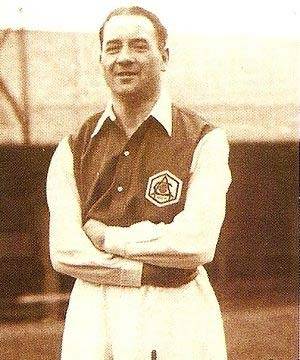
Alex James 

Sir Frederick was a director at Highbury , and he placed Alex James above all the other players he had seen during his long involvement with the association  game. James was a playmaker- a  withdrawn inside forward who orchestrated the play for Herbert Chapman's Arsenal. James gained a paltry 8 Scotland caps, due largely to Preston North End's reluctance to release him for international duty during the 4 rather fractious seasons he spent there.  


Alan Morton

A dazzling outside left, Morton's success was built on balance, the exploitation of limited space and mesmeric ball control. 
 For Rangers he played 495 games and scored 115 goals, winning 9 league championships and a Scottish cup. He made 31 international appearances for Scotland.  

Bobby Templeton

Something of a peripatetic career for the outside right who was capped 11 times by Scotland. He played top level football for 17 years and in that time represented 6 clubs in 7 spells (Aston VillaNewcastle UnitedWoolwich Arsenal,CelticKilmarnock (2 spells) and Fulham.).
Sir Fredrick Wall's prose was more modest than that of William Pickford, who wrote:
Templeton is afflicted with a large measure of the eccentricity of genius. He is a man of moods. When "the afflatus" is upon him he is a winged horse to whom a spur is useless, and whom a curb cannot hold. It is then that the watching multitude is aflame with mingled surprise and admiration - surprise at the wondrous versatility of the man, admiration at the grace and beauty of his movements.
 Association Football and the Men Who Made It (1905)


Billy Meredith

Sir Frederick was clearly an admirer of wing play. The Welsh Wizard (who once told journalist James Catton that he wished he'd been born English)  played over 300 games for each of the Manchester clubs, and also managed 48 appearances for Wales in a 25 year international career. He was a professional for 34 years.

25.9.12

Archie Hunter


Archie Hunter was a prince of dribblers. It was not an unusual performance of his to start at the half way mark, and dribble through the whole of the opposing team! he would not lose the ball until he had literally dribbled it between the posts.
Alfred Gibson and William Pickford in Association Football And The Men Who Made It (1906)

Archie Hunter joined Aston Villa from Ayr Thistle in 1878. Records of his career are incomplete because most of his games were played in the pre Football League era. He was never capped for Scotland because he played for an English club (this was the convention at the time). Hunter was captain of Villa when they won the FA Cup for the first time (1887). His career ended prematurely when he suffered a heart attack in a game against Everton in 1890, at the age of 31. He died four years later.

12.9.12

Vivian Woodward

His mind is full of ideas which he is constantly putting into shape...he can develop a plan as he runs...
In these days, whilst the game in its most highly developed stages is passing largely  into the hands of the paid player, it is well to know that we have an amateur of the class and calibre of Vivian Woodward, who would scorn to do a mean action and is incapable of an unfair one.
Alfred Gibson and William Pickford in Association Football And The Men Who Made It (1906).

Vivian Woodward was an architect by profession. He began his football with Clacton Town, joining Tottenham Hotspur in 1901, and then moving on to Chelsea in 1909. 
He won 23 caps for England (1903–1911) scoring 29 goals.
He also made 30 appearances for the England Amatuers from 1906–1914, scoring a remarkable 44 goals. For England Amateurs he scored a hattrick on 3 occasions,4 in a match on 2 occasions, and six goals on one occasion. 
Woodward won Olympic gold medals in 1908 and 1912.