Showing posts with label Formations. Show all posts

30.10.12

Some Systems...

To summarize the development of tactical formations- in the earliest days Association Football was based on all out attack (although the scores from those days, rather than suggesting goal-fests, have a modern familiarity).
Attacking moves were launched by long balls from the backs and individual dribbling and rushes by the massed forwards.
The 2-2-6 of Queens Park, Scotland and the Royal Engineers was about advancing the ball with more subtlety and certainty through passing (the Combination Game).
This was refined in the 1880s when one of the two centre forwards withdrew into midfield, creating the pyramid (2-3-5) and developing the role of the centre half.
The  centre half was a  fulcrum who had a key role in launching attack when in possession and countering  the opposing centre forward when in defence. They were the playmakers of the era.
The emphasis  remained firmly on attack, which was largely dependent on the two wide forwards taking on the full backs, getting to the by line and sending crosses into the box.
The 1925 change in the offside law was designed to favour the attacking side as clever and coordinated defences were exploiting the 'three defenders' rule to close down the space available. In the last season of the old offside law 2.5 goals per game were scored in the Football league. In the first season of the new rule this rose to 3.4. Paradoxically though this development led to the emphasis in tactical thinking shifting towards the defensive aspects of the game.
The origins of the third back are obscure and controversial- and I argue that it is simplistic to attribute its introduction solely to Chapman and Buchan seeking to redress the balance following the change in the offside law- and a 7-0 drubbing at Newcastle. However, analysis of Chapman's contribution to tactics shows that sound defence was the foundation on which all his innovations were based. 
From this point on tactical developments began to be about stopping the opposition playing, and Italy's Vittorio Pozzo stated this quite openly.
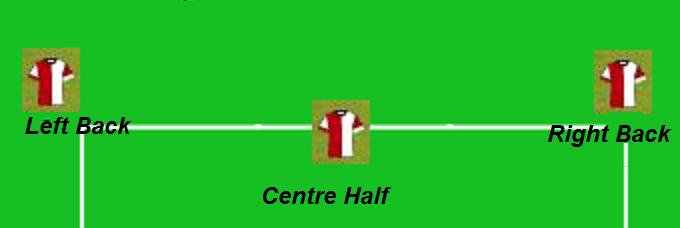


The back 3 in the WM (3–2–2–3)- the centre half drops back slightly behind the full backs and becomes responsible for the offside trap and adopts the role of 'stopper'.


 Pozzo introduced a successful system known as Metodo. Pozzo, who referred to the formation as sistemo, utilized the tirelessness of  Monti in a centro mediante position. When Italy were in in possession he retained his position as a creative midfielder, but would drop back to neutralise the opposing centre forward without becoming a pure defender. The withdrawal of the inside forwards into midfield to compensate for the lessening of the centre half's creative endeavours created a 2–3–2–3 set up.
Criticism of Monti's deployment in this position had echoes of the criticisms levelled at the third back in England- his role in the 1934 World Cup was described as being that of a spoiler.


The back 4 of the verrou.

Another significant rearrangement comes right at the end of our period. The Verrou-the bolt - saw the addition of a fourth defender. This system, introduced in Switzerland by Karl Rappan, set the stage for post war defensive developments. It suited teams with limitations (it has been referred to as being about  the right of the weak). Greater emphasis was placed on cohesion rather than  reliance on skill. It was also reflexive, with positions responding to the state of play, with players dropping back when out of possession, but the  most important development was the introduction of the ultra defensive central defender- the bolt.


27.9.12

Herbert Chapman


Herbert Chapman (1878-1934) was once described as the first manager who set out methodically to organize the winning of matches. He is famous for his role in bringing about the change in the traditional 2-3-5 formation to the WM (3-2-2-3). Chapman also questioned the wisdom of the prevailing tactics of the day- wingers dribbling to the by-line and centering the ball, which he dismissed  as giving the advantage to the defenders. He favoured inside play, the ball being moved incisively into the danger area via the inside forwards. Bernard Joy wrote that Chapman's tactical innovations significantly altered the role of every outfield player. But he also made innovations in other areas. He introduced team talks and tactical discussions. He put the white sleeves onto Arsenal's jerseys, believing that they would be more easy for teammates to pick out with their peripheral vision. Chapman was an enthusiast of continental football. he advocated international club competition and even tried to bring overseas players to Arsenal when this was almost unheard of. Floodlit football and shirt numbering were other causes he championed.
On a lighter note Chapman was the first manager to arrange for music to be played over the PA before the match and during half time.

Do clubs realise to the full today the importance of the man who is placed in control? They are ready to pay  anything up to £4000 and £5000 for the services of a player. Do they attach as much importance to the official who will have charge of the player? the man behind the scenes who finds players, trains talent, gets the best out of the men at his command is the most important man in the game from the club's point of view.
The Sporting Chronicle 1925

1908-09 - Northampton Town- Southern League Champions.
1922-23 -Huddersfield Town-FA Cup Winners
1923-24- Huddersfield Town- Football League Champions
1924-25- Huddersfield Town- Football League Champions
1929-30 - Arsenal -FA Cup Winners
1930-31- Arsenal -Football League Champions
1931-32 Arsenal -Football League Champions

3.9.12

Scotland 1879


In their first international of 1879, against England at Kennington Oval, Scotland played a very progressive 2-3-5 line up (England playing 2-2-6).

Robert Parlane   (Vale of Leven)

William S. Somers (3rd Lanark)
Thomas C. Vallance (Glasgow Rangers)

Charles Campbell (Queen´s Park) 
John Campbell McLeod McPherson (Vale of Leven)
William Wightman Beveridge (Ayr Academy) 


Dr. John Smith (Mauchline FC)
John McDougall (Vale of Leven)
Robert Paton (Vale of Leven)
William Muir MacKinnon (Queen´s Park) 
Henry McNiel (Queen´s Park)


The match was postponed due to snow from April 1st to April 5th. England scored in the 5th minute, Scotland were 4-1 up after 41 minutes, England came back to win 5-4.

4.8.12

Wanderers v Queen's Park, 1872 - 1876

On 5th March 1872 Queen's Park met Wanderers in the  FA Cup semi final at Kennington Oval. The game finished  goalless. Queen's Park, however, could not afford to travel for the replay and withdrew from the competition.


In October 1875, Wanderers travelled to Scotland for the first time to play Queen's Park. Wanderers fielded their strongest side, but were beaten 5-0.A look at the programme above reveals the sophistication of Queen's Park in relation to their opponents.
Queen's Park effectively lined up 2-2-3-3, whereas Wanderers still had a primitive 1-2-7 set up. This reflects the way in which  Queen's Park  relied on purposeful passing and back up.
The London club gained its revenge four months later, however, when Queen's Park travelled to London for a re-match and lost 2–0. This was the first match the Glasgow club had lost in their 9 year history.

27.7.12

2-3-5

Throughout most of the 74 year period covered by this blog, 2-3-5, or the pyramid, was the dominant formation in football.
The emphases in early association football were on attack and individual skills. Formations, such as they were, consisted of a goalkeeper,a half-back and a three-quarter as defenders, with eight forwards.
In the 1870s one full-back, two half-backs and seven forwards became more common.  It has been suggested that Wrexham was the first team play three half backs and five forwards, but the durability of the system was cemented by the success of Preston North End in the 1880s. This was in no small part due to the introduction of Scottish players into the leading English clubs of the day; the "Scottish style"  placed more emphasis on passing than dribbling.  The pyramid established a balance between attack and defence: the two fullbacks were responsible for the opposition wingers, while the halfbacks sought to neutralise the other three forwards. The centre half had a key role in both orchestrating the team's attack and marking the opponent's centre forward.  The pyramid system was prevalent until 1925 when the  offside rule was amended, and teams sought ways of turning the change to their advantage.


11-Outside left
10-Inside left
  9-Center forward
  8- Inside right
  7-Outside right

  6-Left half
  5-Center half
  4-Right half

  3- Left back
  2- Right back

   1- Goalkeeper


(note: shirt numbers were not introduced until 1928).