Showing posts with label Blackburn Rovers. Show all posts

28.5.17

FA Cup Winner's Parades


Athletic News 04.04.83

Manchester United, 1909

Blackburn Rovers, 1928

As the first non-metropolitan team to triumph in the FA Cup it is unsurprising that Blackburn Olympic were also the first to be feted on their return 'home'.
The tradition endures, although the brake pulled by a team of 4 greys is sadly no longer a feature. 


13.10.16

Geary equalises for Everton


29.11.90
Plenty of animation behind the goal at Anfield. Not much sign of life in the Blackburn defence though.
Fred Geary played 100 games for Everton in 6 seasons, scoring 86 goals. This was his 13th goal of the season 1890-91, which he ended with 20.


1.10.16

Blackburn Rovers


There's always one isn't there? In this case it appears to be Arthur Cowell, on the extreme right. I've checked other Rovers pictures from  the era and there doesn't appear to have been a tradition for one of the jerseys to have been in contrast to the others, so maybe Cowell just has his top on back to front?

The players pictured are: Miles Chadwick, Arnie Whittaker, Bob Crompton, Sammy McClure, Adam Bowman, Willie McIver, Tinker Davies, Fred Pentland, Sam Wolstenholme, Billy Bradshaw & Arthur Cowell.

I first saw this picture on https://twitter.com/footballmemorys


31.8.16

Ned Doig

Ned Doig joined Blackburn from Arbroath in 1889. His only appearance for Rovers was a 9-1 win over Notts County. 
Doig made his debut for Sunderland in September 1890 and went on to make 454 first team competitive appearances for Sunderland, winning 4 First Division Championships.
He joined Liverpool (in Division 2) in 1904 and made 53 appearances for the Reds spread over 4 seasons. 
Ned Doig represented Scotland 5 times over a 16 year period, finishing on the winning side 4 times. 
Doig was originally an outfield player who took to goalkeeping with Arbroath Reserves as a 17 year old. Concious of his hair loss, Doig was never seen without his cap, which he would fasten under his chin with a piece of string. 
On Easter Saturday 1900 Doig was involved in a curious incident-  Manchester City goalkeeper Charlie Williams appeared to become the first goalkeeper to score from open play in the Football League, his long clearance eluding Doig. Some contemporary reports (there was no dubious goals panel!) say that Doig made the decisive touch, and credit him with an own goal. ENFA credits City inside left Fred Williams with the goal. Sunderland won 3-1.


 Manchester Courier and Lancashire General 16.04.00

21.5.16

Spot The Ball

Spot the Ball competitions used to be very popular, appearing on the back pages of most newspapers, with large cash prizes on offer.  To mark FA Cup Final day here are 4 Cup Final Spot the Balls. Click on the date to reveal the solution.

1882


1909 


20.3.16

The physique of the operative classes...


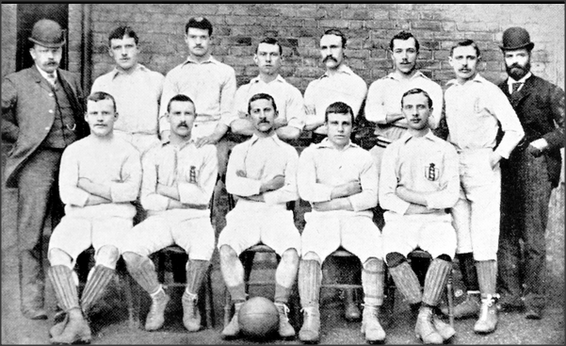
Blackburn Rovers 1891: Back: Tom Brandon, Rowland Pennington, John Barton, Jack Southworth, George Dewar, Jimmy Forrest; Front:Joe Lofthouse, Nat Walton, John Forbes, Coombe Hall, Billy Townley.

In the 1870s and early 1880s bulk and muscle had remained a considerable factor when appraising the qualities of football XIs. Accounts of the first international draw attention to the size advantage that England enjoyed, and the early 'inter class' matches such as Darwen v Old Etonians also drew attention to the physical superiority of the more privileged classes. 
Until the introduction of professionalism (legally 1885 but in real terms c. 1879) working class players would have been seen as being at a disadvantage due to both long term ( the effects of poor diet and sanitation) and more immediate (50 hour working weeks) factors.
The advent of professionalism led to sinecure jobs and the evolution of training and physical preparation., 
The following , taken from Hansard, are the words of  William Coddington MP , debating the 
Factories and  Workshops Bill (18.06.91). Mr Coddington was Member of Parliament for Blackburn from 1880-1906. 

Before the Committee, in support of the statement that the physique of the operative classes was not to be despised, I quoted the fact that a celebrated Lancashire Football Club, the Blackburn Rovers, had won the Association Cup five times, and another Blackburn Club had won it once. I understand that the Member for Poplar, in the early part of this Debate, referred to what I had said on that point, and I believe he quoted from this very paper certain figures respecting the players. I have reason to know that those figures are inaccurate. To show that I was right in my assertion I may say that the Rovers team in 1884 contained three operatives and four sons of operatives; in 1885 it contained two operatives and four sons of operatives; in 1886 two operatives and one son of an operative; in 1890 two operatives and one son of an operative. It is quite clear that the number of operatives in that celebrated team are not so many now as they were several years ago, but that is due to the fact that football has become much more a professional game than it was a few years ago. It is a great misfortune for the town in which I live and for all the other towns which try to emulate each other in this noble game. A very fair proportion of the players in the old times, however, were operatives. The Blackburn Olympic team when it won the Association Cup in 1883 contained five operatives and one son of an operative. These facts prove, at all events, that the physique of the operative classes is not so bad as represented by some people.

Interestingly, even when professionalism had been legal for 6 years, here is how the Blackburn players of 1891 described themselves in that year's census:

Player
Occupation
Rowland Pennington
Professional footballer
Tom Brandon
Joiner
John Barton
Turner and fitter
Jack Southworth
Musician
Geordie Dewar
Publican
Jimmy Forrest
Innkeeper
Joe Lofthouse
Licensed Victualler
Nat Walton
Coachbuilder
John Forbes
Hosier
Coombe Hall
Professional footballer
Billy Townley
Assistant schoolmaster

1.8.15

Clash of Colours, 1882

When we think of the professional football clubs of the industrialized north that came to dominate the game in the 1880s, it is easy to consider them as being an entirely different entity from the southern clubs of the amateur gentlemen. There was, however, a thread that linked many of the clubs of Lancashire to the public schools from which Association football had developed in the 1860s.
Turton, probably the first Lancashire side, were founded by Old Harrovians (of which more later). The case we will look at here is that of the team that really put the cat among the pigeons by reaching the FA Cup Final in 1882, Blackburn Rovers.


1878:Notice in the picture above how there is inconsistency in the jerseys.

The 'quartered ' shirts and the Maltese Cross motif that Rovers wore in the early days pointed to their (surprising) public school origins. Founder  Arthur Constantine was an Old Salopian (Shewsbury). 


Shrewsbury School, 1912

According to Charles Francis in The History of Blackburn Rovers (1925) several of the 17 present at the  St Leger Hotel On 5th November 1875 were young fellows who had just finished their education at public schools
The stipulation in setting out the club livery was that a Maltese cross be worn on the left breast This motif was worn by both the Shrewsbury and Malvern school teams.


Malvern College

Malvern College  provided Rovers with players such as the Greenwood brothers (Thomas, Harry and Doctor) and Fred Hargreaves.


Blackburn Rovers' strip remains one of the most readily recognisable in the world of football, and was much imitated. However, when their first chance of glory came as they reached the FA Cup Final in 1882 they were denied the opportunity of wearing their famous strip.The 11th FA Cup Final was the first to necessitate a change of colours.
John Lewis recalls a letter from Alcock- there is no evidence that a coin was tossed or any lots were drawn in order to decide who changed kit- Rovers were instructed, by letter. Lewis was convinced that this was a bad omen. Rovers also requested assistance with their travelling expenses; the FA declined.

On the day Rovers wore narrow black and white  hoops in the mode of Queen's Park. Old Etonians wore harlequin shirts of light blue and white (a departure from their previous plain light blue). 


19.1.15

A humiliation that staggered the football world: Swansea Town v Blackburn Rovers- 1915


On Saturday Swansea City travel to Blackburn Rovers in the 4th round of The FA Cup.
When the 2 met in January 1915 for a first round FA Cup tie, the outcome was one of the biggest upsets in the history of British football. 
Blackburn Rovers were a big, big club. Established 40 years previously they were founding members of The Football League. The previous season Rovers had won the Championship (their 2nd title).  They had won the FA Cup 5 times. At the time of this match (09.01.15) they were 5th in Division 1.
Their line up featured 4 England internationals ( Crompton, Bradshaw, Latheron and Hodkinson) and 1 Scottish international ( Aitkenhead).
Crompton had played for England a remarkable 41 times ( a record which stood for 38 years), captaining on 21 occasions. 
Rovers offered Swansea a large sum to switch the match to Ewood Park but the offer was declined and 16,000 people were at the Vetch to see the League champions. 
Swansea Town were in the second division of the Southern League. They had only come into existence in 1912. Their line up that day was light on stars. Club captain Thomas Hewitt had played for Wales 8 times (1911-14). Captain for cup matches that season was Joe Bulcock The man who became a hero that day was a 16 year old Rugby player. Benny Benyon was only playing 'soccer' because Rugby was suspended during the war. 
Blackburn attacked relentlessly from the outset, but in the 20th minute Swansea broke out of defence in a move, started and finished by Beynon, that covered the length of the pitch and gave the Swans an unlikely lead. 
At half time Swansea were reduced to 10 men when Lock was injured. 
Rovers bombarded the Swans goal in the 2nd half. They were awarded a penalty but remarkably Billy Bradshaw, who had scored with 36 consecutive spot kicks, shot wide. Harry Read went off injured and Swansea had to hold out for the last quarter of an hour with just 9 men. 
It was, according to  contemporary newspaper reports: A humiliation that staggered the football world.
As the photograph shows, Swansea Town were unique in having a strip in which jersey and knickers were of the same colour.
Benny Beynon returned to Rugby after the war and played for Wales, but in a ruling that highlights the stupidity of the way in which that game was administered, he was banned for professionalism on account of his Association football exploits. He went to Oldham as a Northern Union player.
Joe Bulcock (Town) and Eddie Latheron (Rovers) were both killed in the war.

Swansea Town

Blackburn Rovers
Hurst
GK
Alf Robinson
Tom Hewitt
RB
Bob Crompton
Joe Bulcock
LB
Tommy Suttie
John Duffy
RH
Bert Walmsley
Lock
CH
Percy Smith
Anderson
LH
Billy Bradshaw
Harry Read
OR
Alex McGhie
Brown
IR
Wattie Aitkenhead
Benny Beynon
CF
Johnny Orr
Gilboy
IL
Eddie Latherton
Amos Lloyd
OL
Joe Hodkinson


29.11.14

Souvenir


A curious memento. And for tissue paper to survive 100 years...
Described as follows in an auction catalogue:
1910 F.A. Cup third round commemorative tissue Imprinted 'Souvenir of the English Cup third round Played at St James Park Newcastle Saturday Feb. 19th 1910', with team pictures and annotation of players names underneath. Floral flag design to outer edges. Printed by Mrs S.Burgess of Bishopsgate, London.

If we look at the teams that played that day we will see that there was plenty of quality on show.  Blackburn Rovers were 3rd in Division 1 and Newcastle United 6th. 

Newcastle United

Blackburn Rovers
Jimmy Lawrence
G
Jimmy Ashcroft
Billy McCracken
RB
Bob Crompton
Tony Whitson
LB
Arthur Cowell
Colin Veitch
RH
Albert Walmsley
Wilf Low
CH
George Chapman
Peter McWilliam
LH
Billy Bradshaw
Jock Rutherford
OR
Billy Garbutt
Jimmy Howie
IR
Eddie Latheron
Albert Shepherd
CF
Ellis Crompton
Sandy Higgins
IL
Wattie Aitkenhead
George Wilson
OL
Walter Anthony

The 54,000 crowd brought in receipts in excess of £2000 (described in the contemporary press as 'an enormous sum').
Higgins opened the scoring in the first minute ( a quick short drive). Rutherford added a second in the 25th minute but Rovers immediately pulled one back through Anthony. Howie completed the scoring in the second half.


18.10.14

Fergie Suter


Following James Reddie Lang's spell with The Wednesday in 1876 the next examples of Scottish players moving to England in order to play football for money are Fergus Suter and James Love, who joined Darwen in 1878.
Glaswegian full-back Suter had played for Partick and Glasgow Rangers. 
Over the New Year holiday in 1878 Partick visited Lancashire and played both Darwen (losing 3-2) and Blackburn Rovers (losing 2-1).
Suter was a stonemason, although it was noted that he didn't continue his trade when he was living in Lancashire. Darwen alays denied he was a professional, but Suter later commented  I would interview the treasurer as occasion arose.
Suter's play drew positive comments in the press- he was an active proponent of combination play, linking with his half backs and forwards and launching attacks himself rather than just seeing his role as being to clear his lines with long kicks. The way in which he lofted free kicks for the centre forward to head also seems to have been an innovation. Suter featured in Darwen's legendary cup run of 1879, but in 1880 he shocked the town by transferring to their neighbours and rivals Blackburn Rovers.


The acrimony wasn't helped when Suter and Darwen's Thomas  Marshall grappled in a cup tie  in November 1880 at Alexandra Meadows. The match was abandoned, the return match was cancelled, and the two sides declined to meet other than in cup ties in the future. 
The local press featured some interesting correspondence in the wake of this match:


 Here is another interesting letter. Transfer gossip and speculation are nothing new:


Whilst with Rovers Suter  appeared in four FA Cup Finals, picking up 3 winner's medals. He was still around when the Football League came into being, but only played in one League match, appearing in goal against West Bromwich Albion on 22nd December 1888.


16.6.14

Newton Heath's League Debut

When the Football League was founded in 1888 it is remarkable that, despite the ascendancy of Lancashire football,  there was no side from Manchester itself in a suitably advanced state of development to be considered for inclusion in the venture. Newton Heath played in the Combination (1888–89) and the Alliance (3 seasons from 1889)  before being elected to Division 1 of the Football League for the 1892-93 season. 
The club became a Limited Company (shares £1) in June 1892. Alf Albut became the first full time club secretary and a number of new signings were secured (including 8 Scotsmen). 
The Heathens first league fixture was away to Blackburn Rovers at Ewood Park on September 3rd 1892. Rather inauspiciously the kick off was delayed until 4pm because Newton Heath arrived late.  
Within 10 minutes of the kick off they were 2 goals down. Southworth shot Rovers into the lead, the second goal, credited to Hall , came from a scrimmage. Rovers went 3 up before Donaldson pulled one back (histories credit Coupar with Newton Heath's first league goal, but contemporary newspaper reports identify Donaldson as the scorer). Coupar then added another from a scrimmage before half time. 

The Manchester Courier and Lancashire General Advertiser reported a closely contested match: for three fourths of the game there was nothing to chose between the two teams- backwards and forwards the tussle went- both goals being visited in alternation.

 Chippendale put Rovers 4-2 up before the prolific Farman brought the Heathens back to within 1 goal.  Incidentally, whereas green and gold are associated with Newton Heath, largely due to the
1992/93 revival kit , the first team colours in the 1892-93 season were red and white 'halves' (more correctly 'quarters').

Warner
Goal keeper: Jimmy Warner
27 year old Warner, born in Lozells in Birmingham, had spent the first 4 seasons of league football as Aston Villa’s keeper. The previous April he had felt the wrath of Villa supporters after the FA Cup final defeat to neighbours West Bromwich Albion. The windows of his pub (Old College Inn, Spring Hill) had been smashed by angry fans. In 1892 Warner was also involved in a scandal regarding an elopement with a woman (he was married at the time).
He had been an FA Cup winner with Villa in 1887.
His Newton Heath career was virtually ended by his failure to turn up for an away match at Stoke in January 1893.

 (1.77m 79.3 kg)
Clements
Right back: John Clements
Clements, 24 , was born in Nottinghamshire and had played 2 seasons of league football for Notts County.
Brown 
Left back- James Brown
I don’t know much about Brown. He only ever made 7 League Appearances and was never on the winning side. 

Perrins
Right half- George Perrins
20 year old George Perrins was from Birmingham. Signed from Birmingham St. George's He was to spend 4 seasons with Newton Heath. 

Stewart
Centre half: Willie Stewart
22 year old Stewart was Scottish- a rangy 1.77m. He had played for Newton Heath in the Alliance, mainly as an inside forward.

Erentz
Left half: Fred Erentz
Another Scot, 22 yr old Erentz spent 10 seasons with Newton Heath, making over 300 appearances. His last match was Newton Heath's last game before they became Manchester United.  Half Danish , he was signed from Our Boys (Dundee).

 Farman
Outside right: Alf Farman
Farman was signed from Bolton Wanderers in 1889. A native of Birmingham he had been on the books of both Excelsior and Aston Villa.  He scored 53 goals in 121 appearances for Newton Heath.

Coupar
Inside Right- Jimmy Coupar
Another Scottish import from Our Boys (Dundee).  Coupar returned to Scotland in Jult 1893, joining St Johnstone.

Donaldson 
Centre Forward- Bobby Donaldson
Donaldson joined Newton Heath from Blackburn Rovers. He was another Dundee man. He finished the season as top scorer for the club with 16 goals. 

Carson
Inside left- Adam Carson
A Scotsman signed from Glasgow Thistle in June 1892, Carson was sold to Ardwick in the summer of 1893 having made 13 appearances for the Heathens. 

Mathieson
Outside left-William Mathieson
A native of Glasgow signed from Clydesdale in the summer of 1892, Mathieson was at Newton Heath until 1895. 


Newton Heath  finished the season in 16th place, and retained Div 1. status by beating Small Heath in a 'test match'.